Martha’s Quarterly 2026
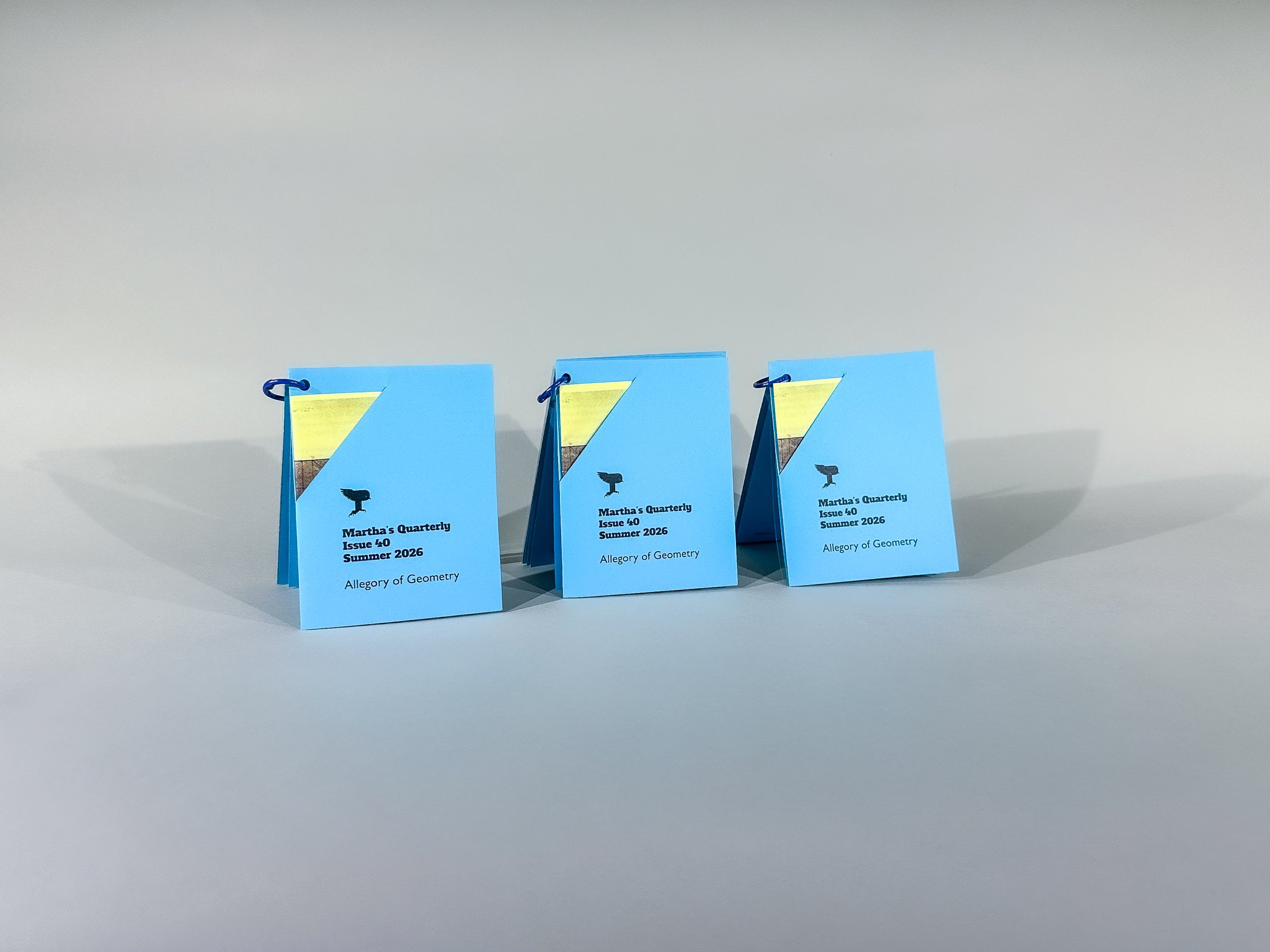
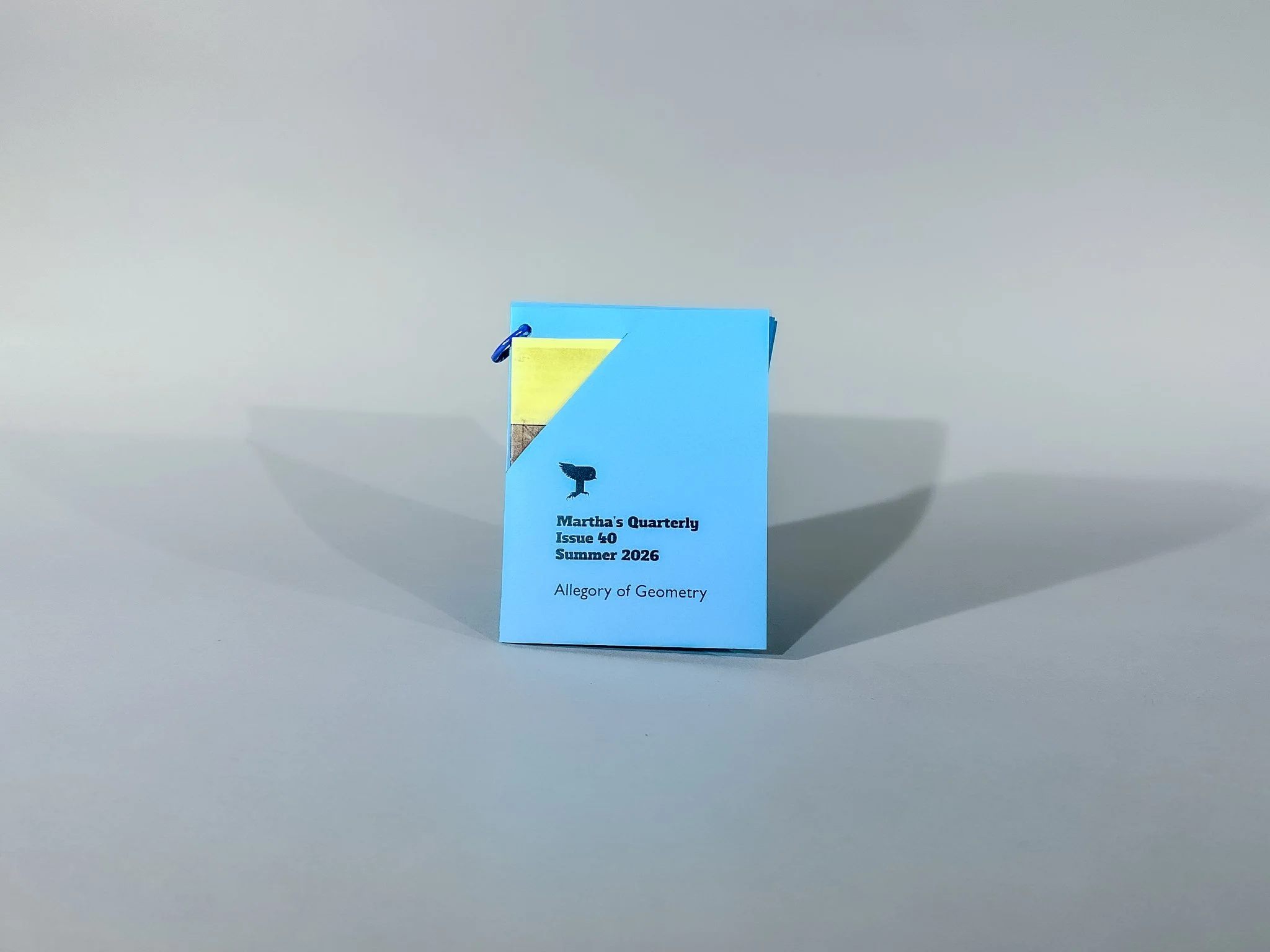
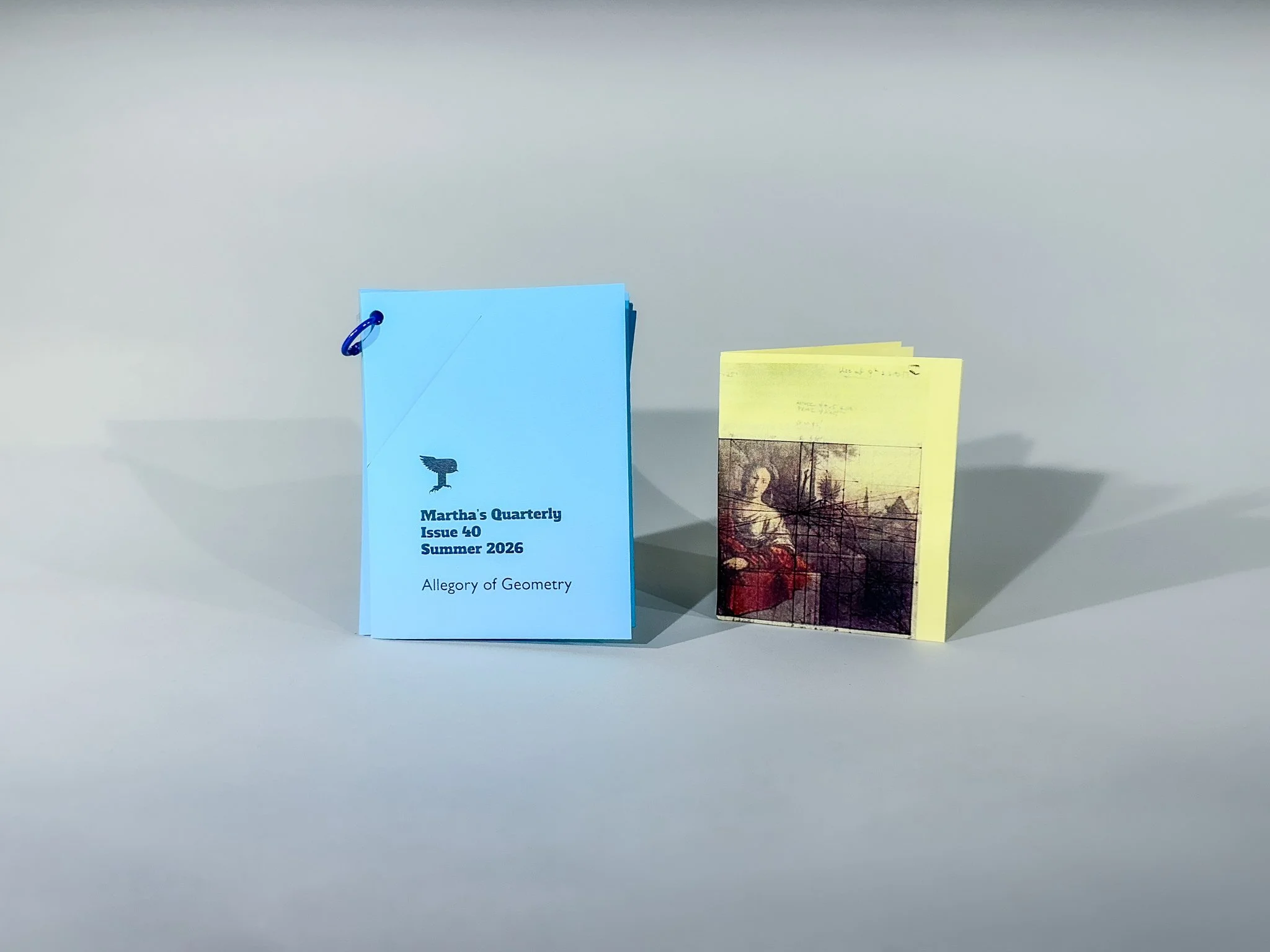
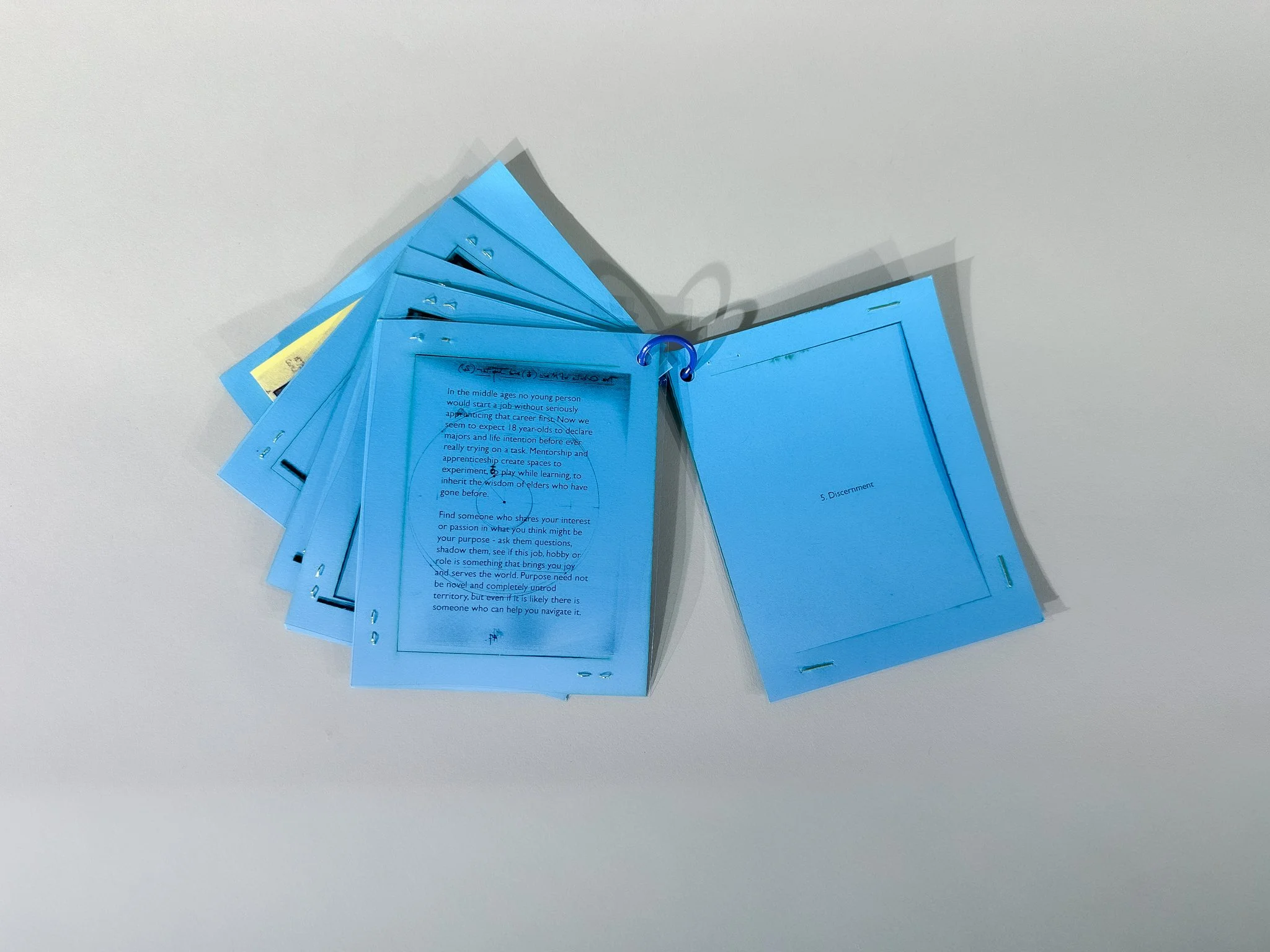
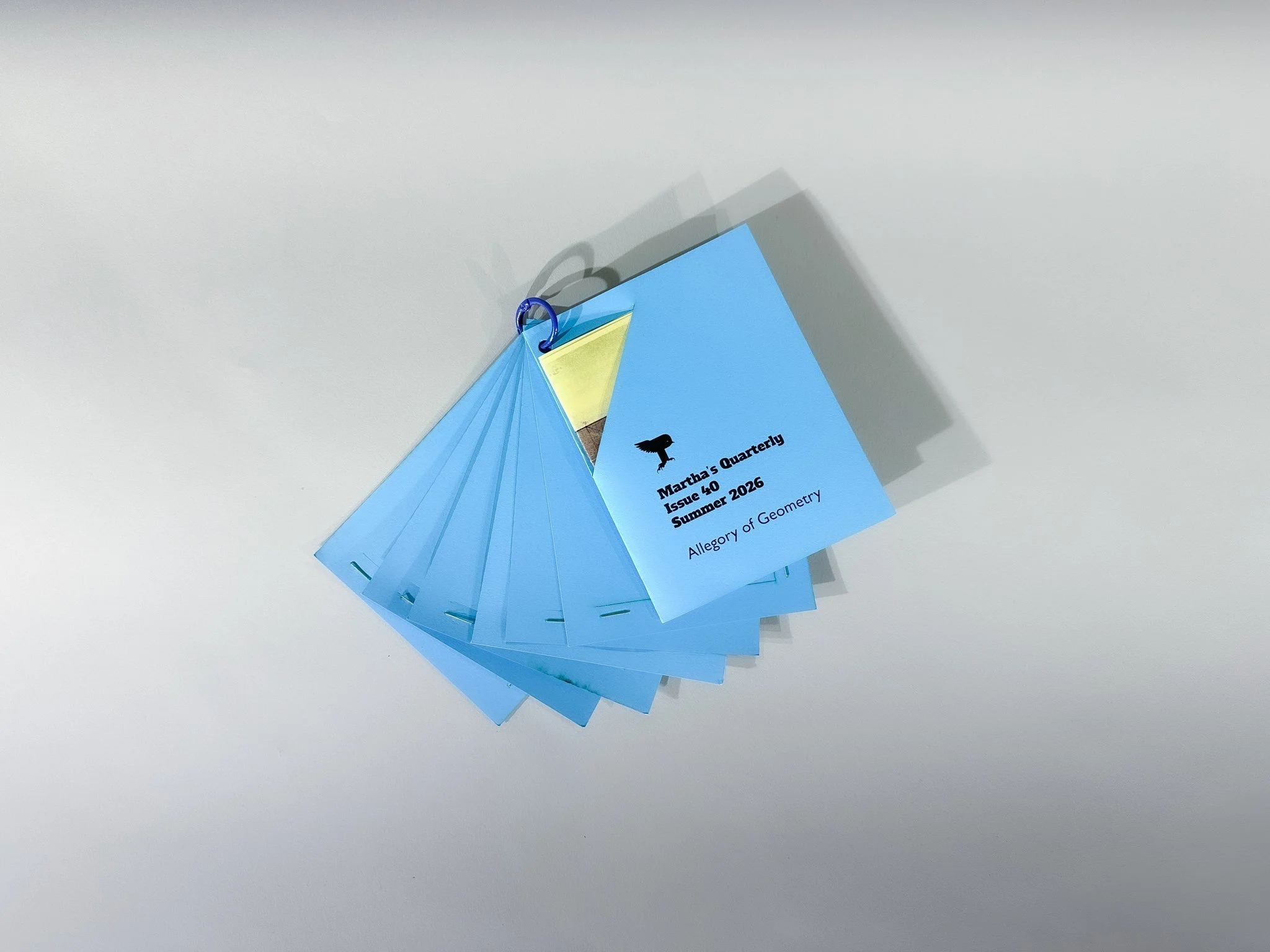
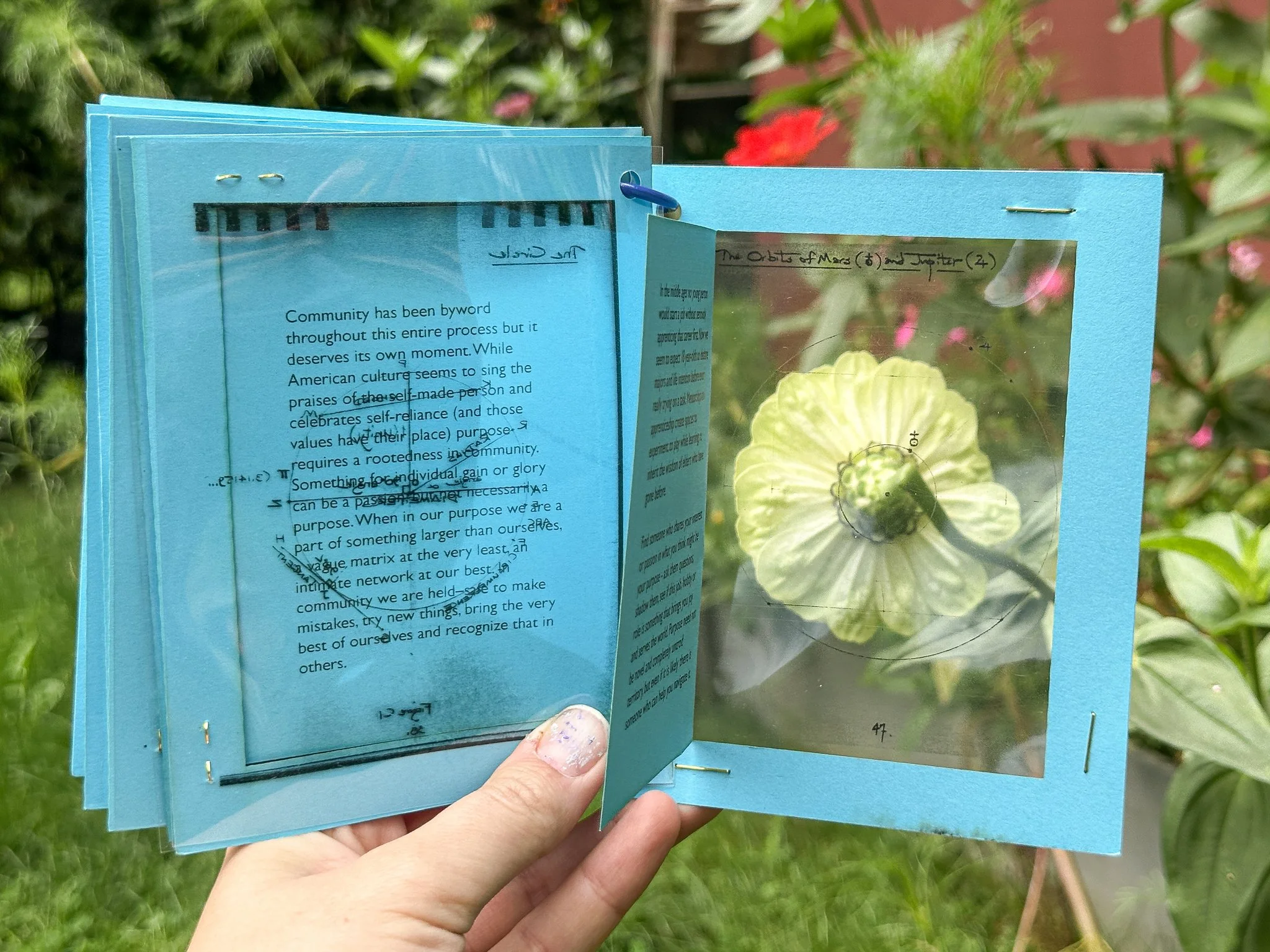
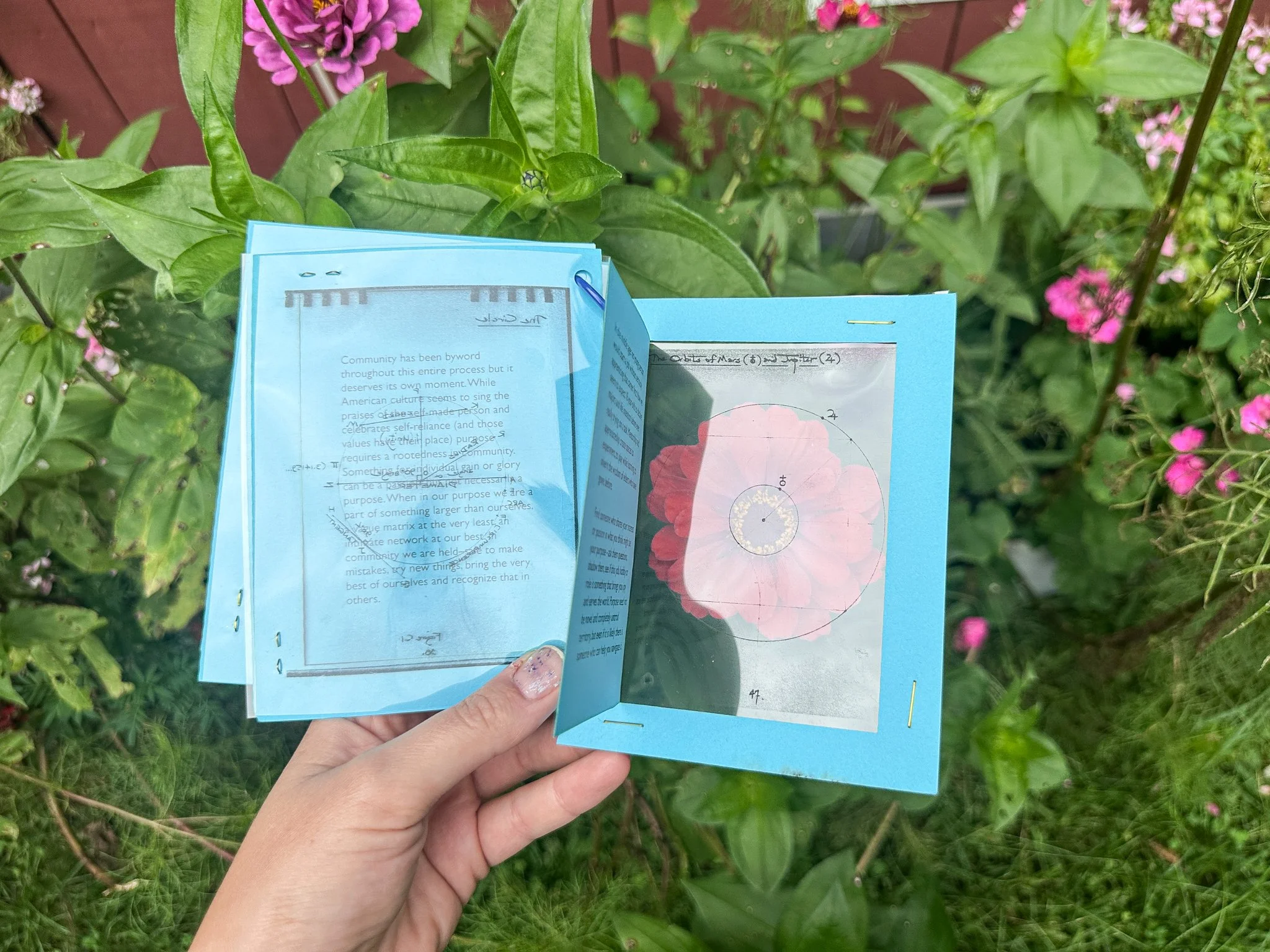
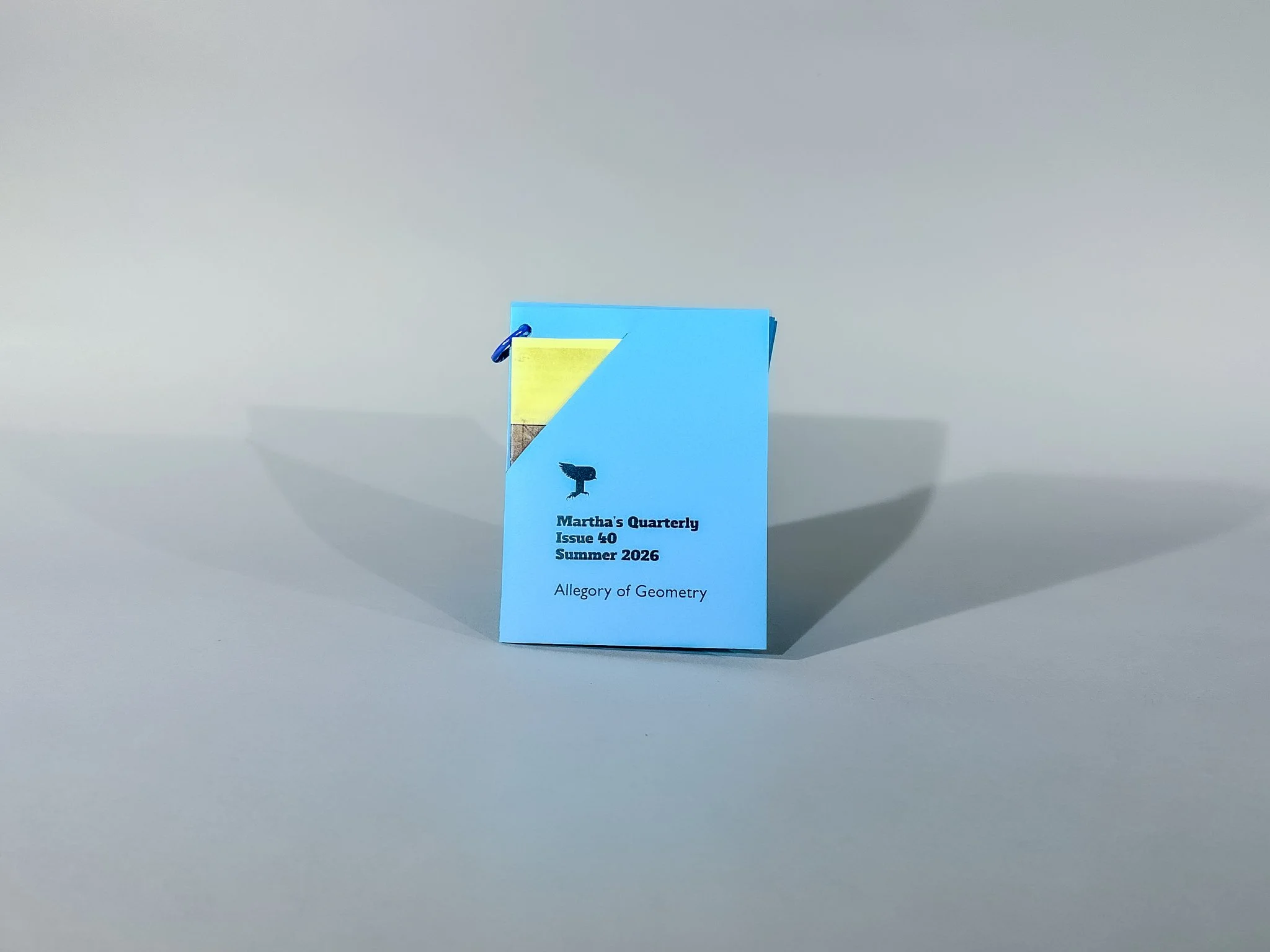
Allegory of Geometry
5.5” x 4.25”
About the Contributors:
Mark A. Reynolds is an artist, geometer, and educator. He has worked with graphite, watercolor, pastel, ink, and other traditional mediums for over sixty years, developing artistic interpretations of traditional principles found in Euclidean and Philosophical Geometry. Mark's work demonstrates his point-of-view regarding geometry as an art form and its interdisciplinary relationship with music, nature, mathematics, architecture, and personal discovery.
Caroline Hughes is an ordained minister in the United Church of Christ. She currently serves the Wilton Congregational Church, where many of her best days involve ministry with young people.
Martha's Quarterly
Issue 40
Summer 2026Allegory of Geometry
5.5” x 4.25”
About the Contributors;
Mark A. Reynolds is an artist, geometer, and educator. He has worked with graphite, watercolor, pastel, ink, and other traditional mediums for over sixty years, developing artistic interpretations of traditional principles found in Euclidean and Philosophical Geometry. Mark's work demonstrates his point-of-view regarding geometry as an art form and its interdisciplinary relationship with music, nature, mathematics, architecture, and personal discovery.
Caroline Hughes is an ordained minister in the United Church of Christ. She currently serves the Wilton Congregational Church, where many of her best days involve ministry with young people.
Martha's Quarterly, Issue 40, Summer 2026, Allegory of Geometry, is the last Martha's Quarterly.
I write this in the final days of summer. School has begun again, it's getting chilly, and it seems like everyone is talking about AI. This week alone: Jacob Coxon, a researcher who quit Anthropic, has been on nearly every major outlet warning the public about AI's existential risk;¹ New York's Mayor Zohran Mamdani announced a one-year moratorium on student-facing generative AI in public schools for grades K through 8 in the 2026–2027 school year;² and I'm headed into a meeting this week where one agenda item is whether to add an oral component to honors thesis projects, specifically because of AI. At the same time, I am very interested in using AI, and I do. It has helped me understand some mathematical topics for an opera I've been writing. I have several threads going on home improvement projects. And for the last few years, it has quietly helped me brainstorm these very Martha's Quarterlies.
Ten years ago, in another late summer, I started Passenger Pigeon Press. I was a few years out of grad school, trying to find a way to reach an audience through artwork that brought together disparate subjects, people, and ways of expressing ideas. Artist books have always been the heart of my practice, as I believe the experimental structures of bookmaking let many ideas live and resonate at once through play and exploration. At the time, I was expansively interested in the subject of identity — whose story gets told, whose gets erased, and how a person's sense of self survives being flattened by systems much larger than them. I found I could talk about those human things more clearly through animals. The passenger pigeon became my proxy: a species hunted into oblivion by the millions, its extinction a story about exploitation and belonging that I could tell without flinching because it wasn't technically about people. Martha, the last of her kind who died alone in the Cincinnati Zoo in 1914, became the press's namesake — a small, stubborn resurrection of an extinct species through the act of publishing.³
Martha's Quarterly has always been a pursuit of nuance, and each zine has used many different topics and formats to look at something else. Each article, poem, drawing, photograph, toy, sticker, and more has always been an allegory for something else. While the passenger pigeon was my first proxy to look at identity, the project has made almost everything a proxy for something else, and ultimately the whole catalog is like an allegory for the human condition.
I am very proud of this commitment to nuance, but I have to admit, this pursuit has offered no clarity on any topic — it has only made me more confused. This is where Martha's Quarterly has quietly evolved into something of a pushback against zine culture's proud history of advocacy. Ask anyone who has ever made one, or bought one from a folding table at a book fair — the form itself seems to assume a position, a message, something at stake. But after ten years and forty issues, I don't think I've become an advocate for very much at all. Instead, the process of learning — and of getting older — has made me profoundly humble. In the process of making these publications, I found myself listening more to conservatives and religious people than I once did. Even as I've kept listening to progressives and radicals, I find my own mind endlessly agitated, unable to rest in clarity, constantly vibrating in contradiction. This restlessness, though, has also made me more compassionate toward nearly everyone's plight than I had the range for a decade ago.
In the last ten years, my responsibilities have also expanded. I am now a professor, an artist running a business, and a mother of three. As I've taken on these roles and kept working with young people, the subject that keeps coming back to me is purpose. It's something I feel everyone should seek and possess — but what is it, and how do you find it?
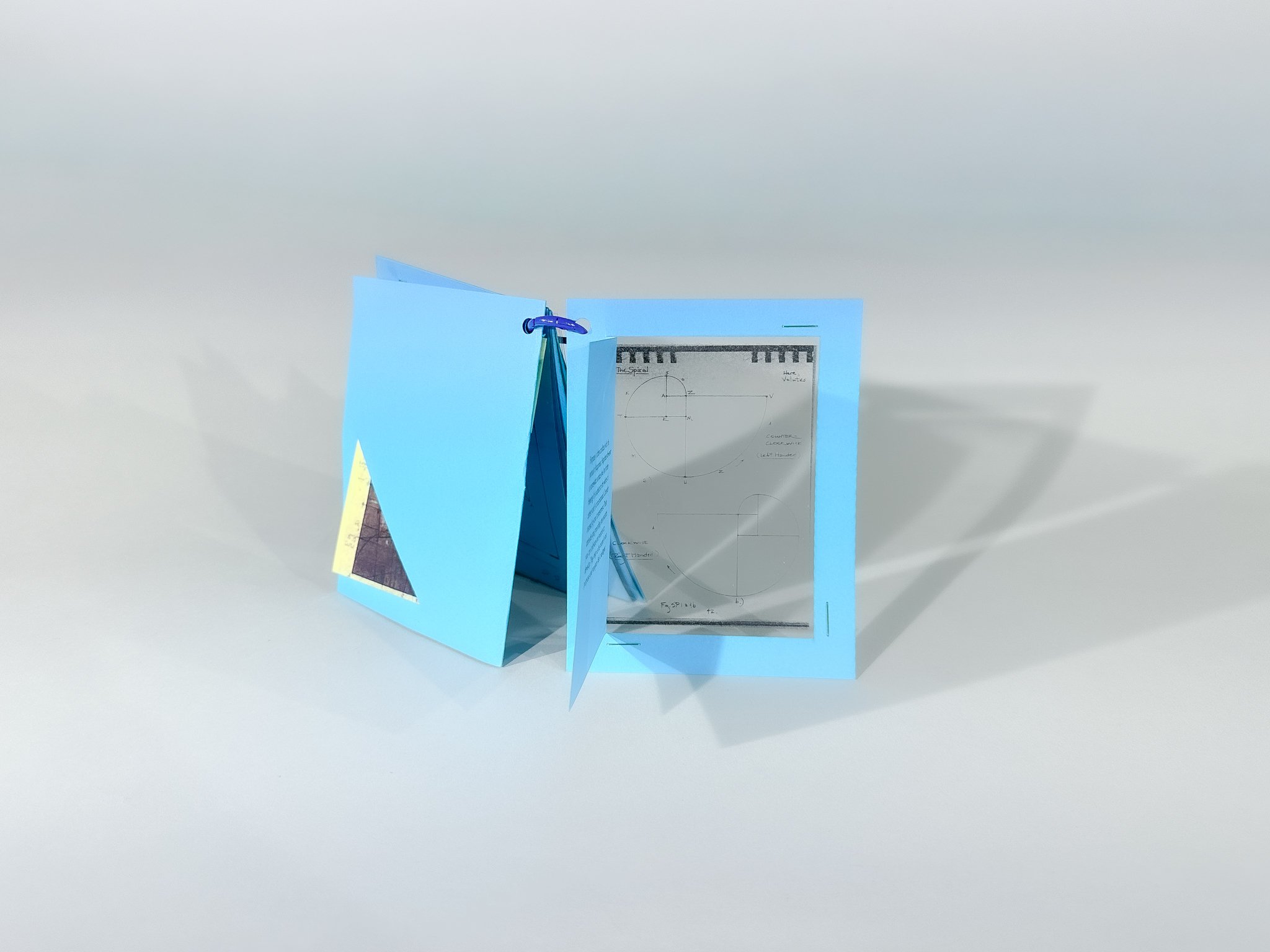
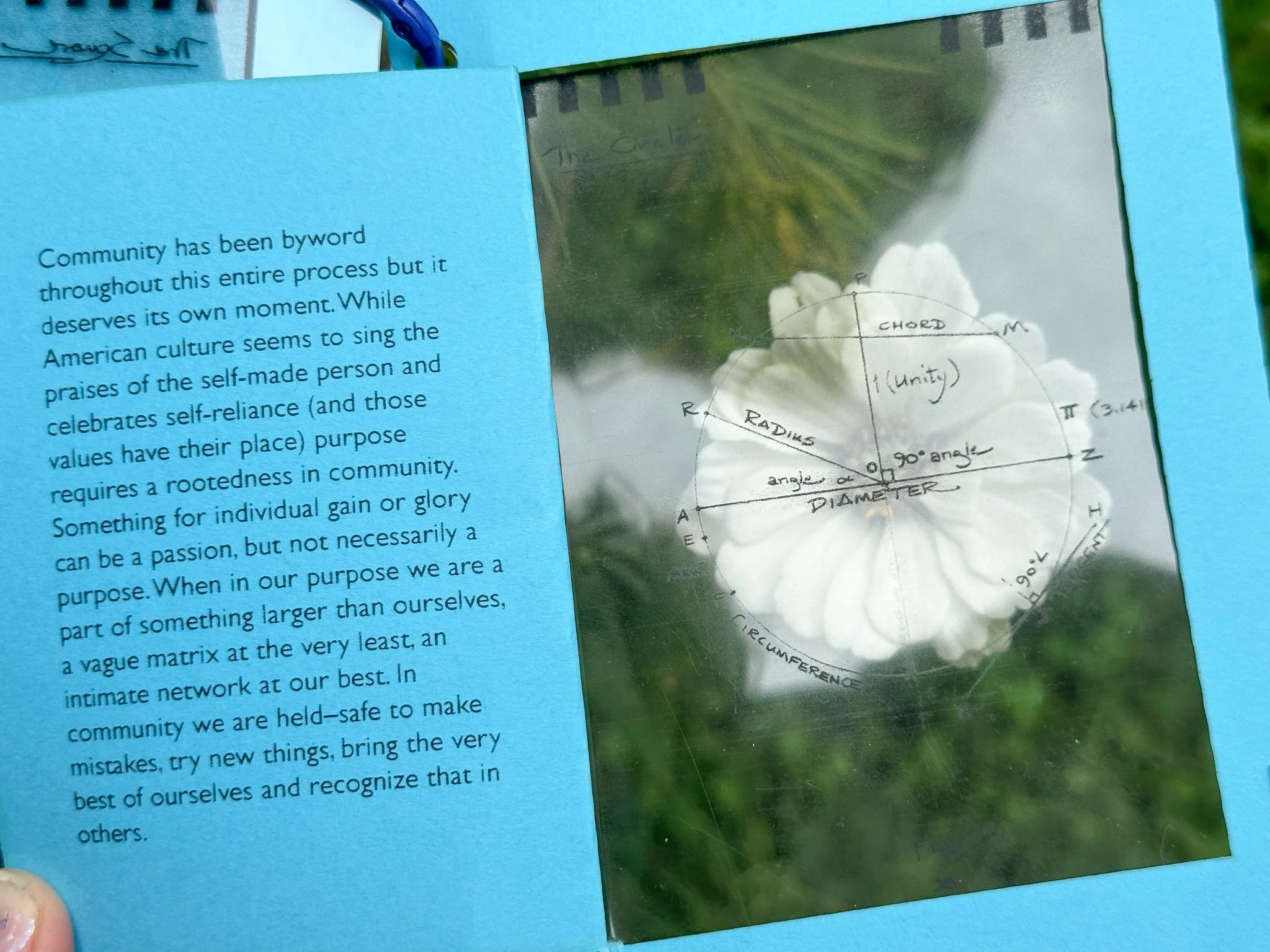
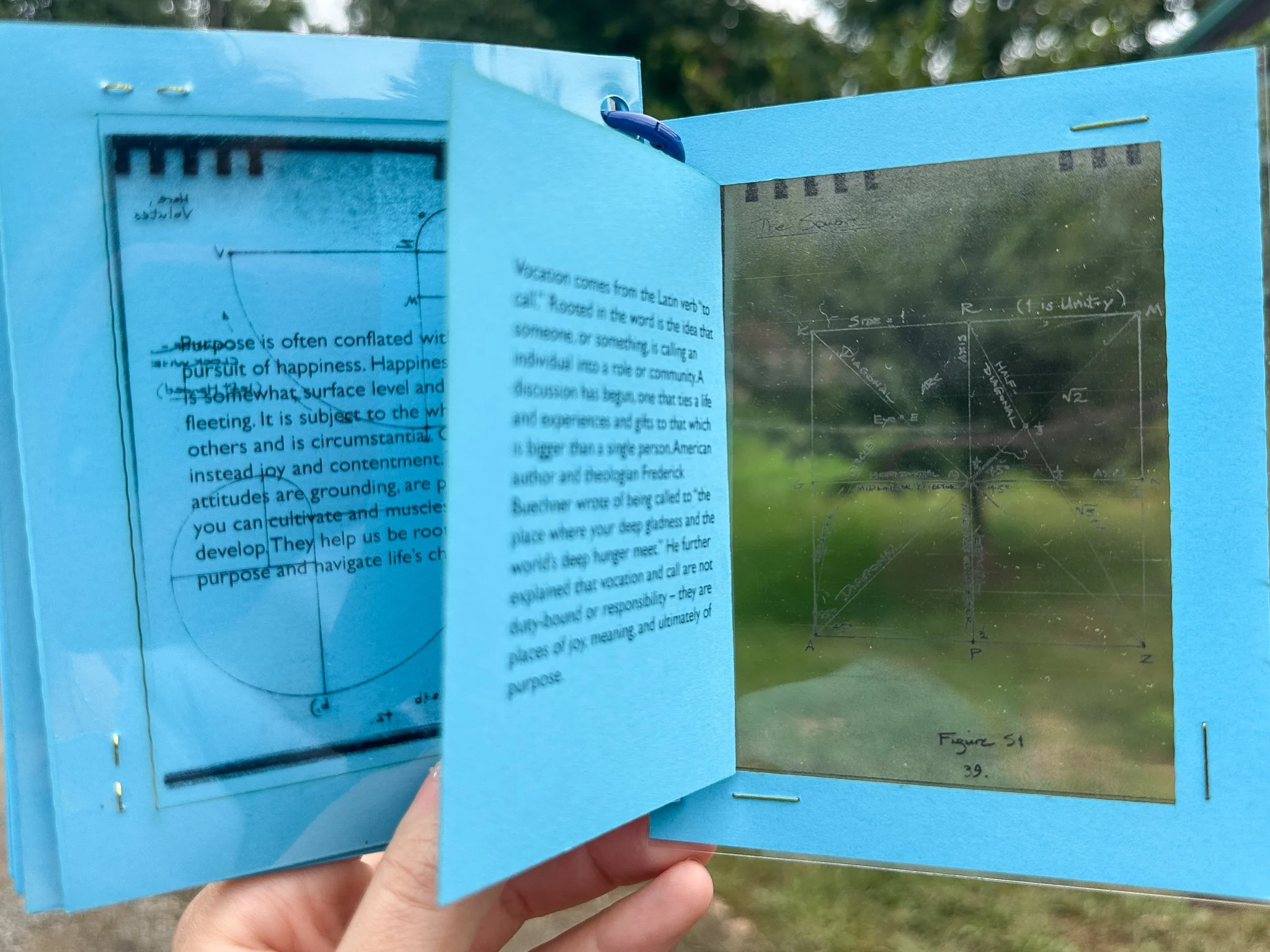
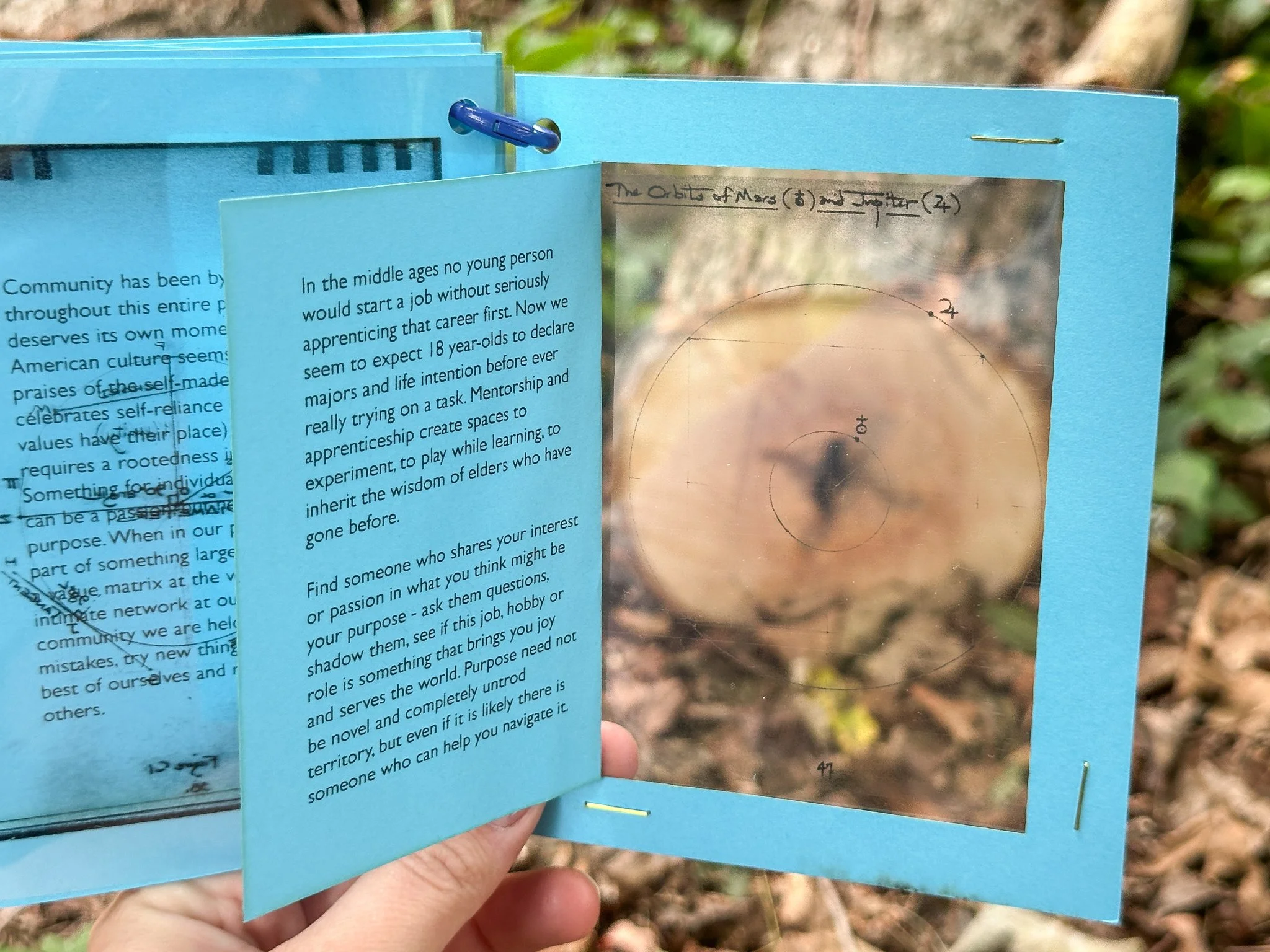
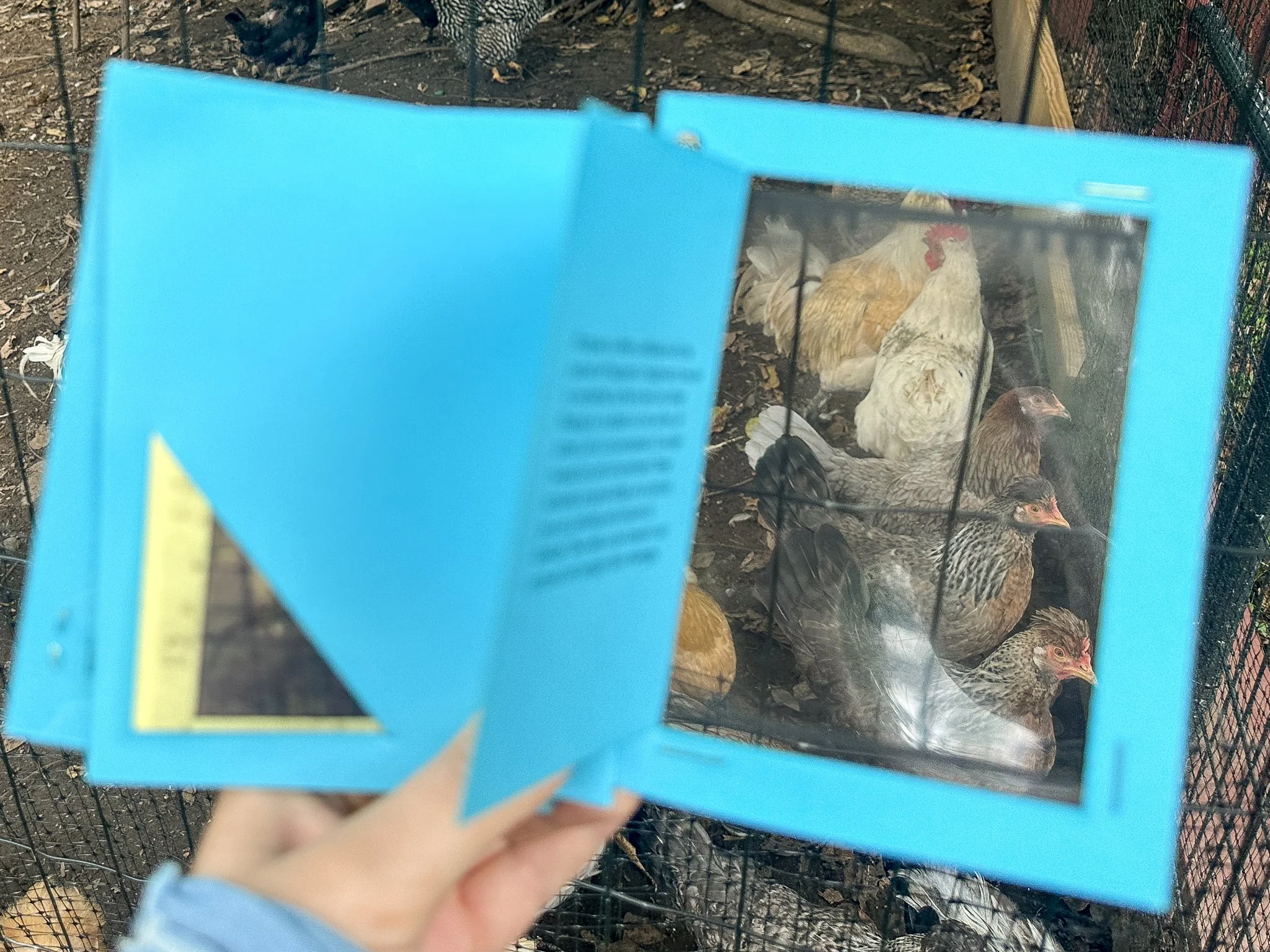
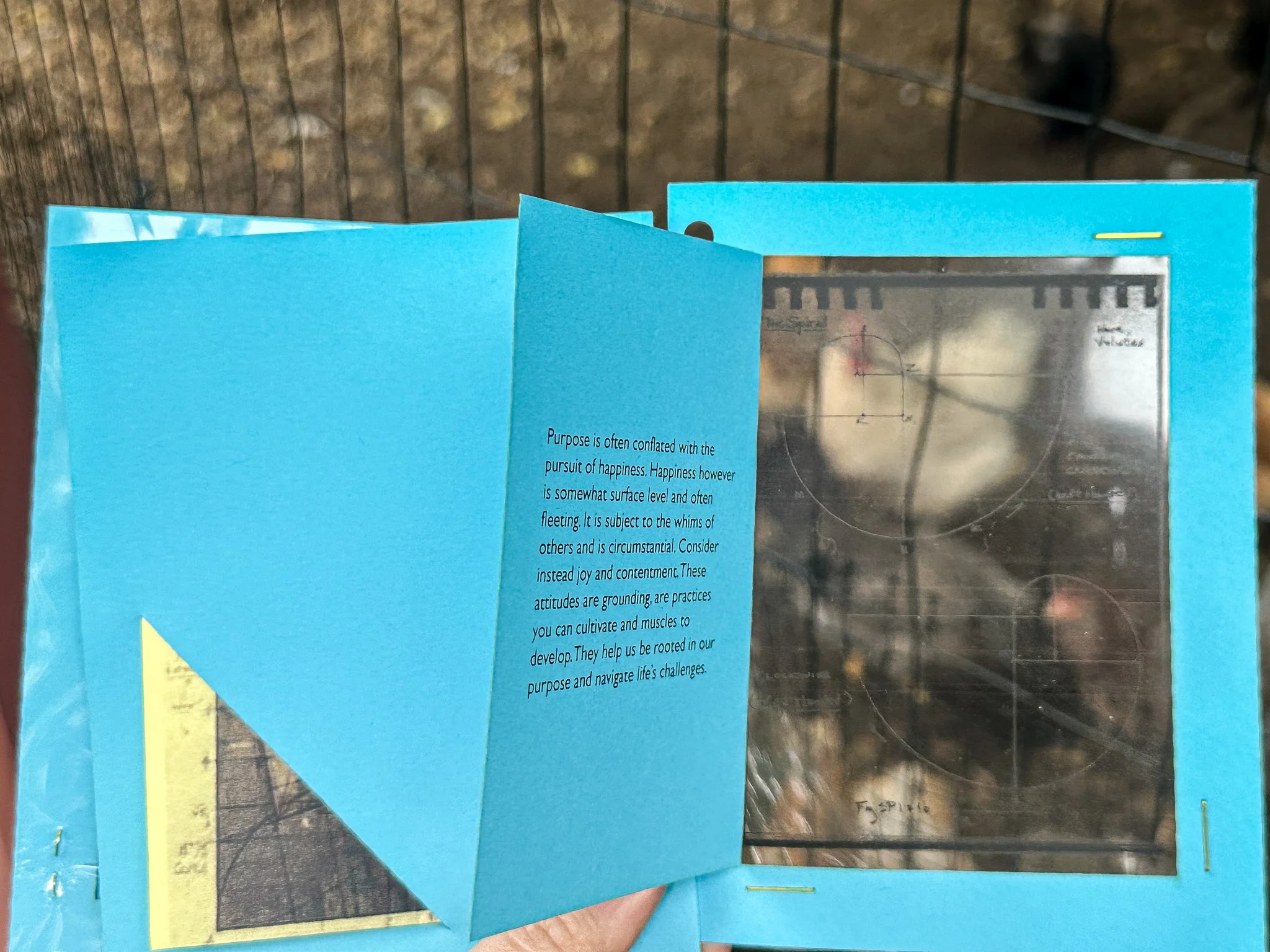
This Martha's Quarterly, Allegory of Geometry, is a deck of cards with fold-outs that hangs on a keychain. On the other side of this introduction, you'll find a flow chart by Caroline Hughes titled "Is This My Purpose?" I've learned a lot from engaging my family with her church, where questions about God and spirituality are posed in wonderfully generous, broad, open-ended ways — one of many reasons I wanted to invite her to respond to the question of purpose. Her response is a fun, "no-pressure" flow chart that walks you through a cascade of questions. When you arrive at "your number," you find it on one of the cards, where Hughes offers something to reflect on. But there's more: the card opens again to a viewfinder with a geometry drawn on it by the artist Mark Reynolds — hold it up, and you can see the world through its logic.
Over the summer, I had a lovely time visiting the Legion of Honor in San Francisco, where a friend introduced me to Allegory of Geometry, a 1649 painting by Laurent de La Hyre. In it, a robed woman — Lady Geometry — holds up a sheet of geometric drawings, a compass and square in her other hand. It was while admiring this painting that my friend told me about Mark Reynolds, a masterful artist who has spent sixty-plus years exploring geometry through art. The same sheet in this quarterly that holds Hughes's flow chart also carries Reynolds's drawings deciphering the 1649 painting’s geometry, along with a written account of his process, which he shared with me. Reynolds found that the canvas is not, as it first appears, a simple golden-section rectangle, but a golden section with a double square added to it — 1.618 plus 0.5, for a ratio of 2.118. Working out the four golden-section "caesuras" that this ratio produces across the canvas, he discovered that La Hyre had placed one of them, with obvious deliberateness, exactly on Lady Geometry's eye.⁴
"Purpose" was on my mind the day I saw Allegory of Geometry. In Issue 37, I brought up Jensen Huang's interview on the Joe Rogan podcast, and it's a conversation I keep coming back to. Huang, whose presence is now met with massive crowds all over the world, is one of the world's most consequential CEOs. On the topic of AI, he kept circling back to one question: what is the purpose of the job, and has that purpose changed? Take a chauffeur, he said — if the car becomes self-driving, will every chauffeur lose their job? Probably not, because for some passengers the driver was never just a driver: "they could be protectors... part of the experience, part of the service." Some jobs disappear, some change, and the technology finds new homes. Then he turned it on himself: "I actually don't believe I'm going to lose my job, because my purpose isn't to look at documents, study emails, or read diagrams — that's part of the job, not the job. A lawyer's purpose is to help people, and that probably hasn't changed." A few moments later, though, when asked if he thought that task-based jobs would be replaced by AI, he added: "Yeah. If your job is the task. That’s a lot of people."⁵
I think it is much more than a workplace disruption. For some people, this won't be a bump in the road — it will be horribly, permanently life-changing. And yet I am also excited by AI. I use it because it is fast, and even though it makes mistakes, it's often accurate enough. It lets me accomplish in an afternoon what used to take a week. But that same efficiency and speed, which lifts so much mental weight off the brain, is exactly what I fear crowds out the harder work — taking time on something, focusing on it, reflecting on it, staying with something difficult long enough to earn the wisdom within hindsight that eventually points toward purpose.
In some way, I hope these viewfinders, paired with the flow chart, offer a chance to take time and look around. What I love about playing with them is that you can hold them up to absolutely anything — your bedroom, a plant, a bug, a whole skyline — and the geometry fits. It is as if you could impose a little logic onto a chaotic, purposeless world just by looking at it through the right shape. The two that excite me most are the Mars and Jupiter orbits and the musical ratios, because they connect the world in front of you to something that isn't your world at all — planets, not sidewalks, in one case; something that isn't even visual to begin with, in the other. A viewfinder doesn't work if you rush it; slowness is built into using it well. You have to hold it up, hold still, tilt it, and wait for a shape to resolve out of a window frame. Play with it, explore with it. It might not answer the question of purpose, but it does offer time to look.
That's all for Martha's Quarterly, then — but I'll end with this. Martha, the last passenger pigeon, will return again in the spring as Martha's Memorandum, a new kind of democratic multiple. It's something I've been working on with some extraordinary young people who went deep into exploring this topic of purpose. There will be artifacts from many histories and interviews with people they know, arriving in a box that you open to find it pouring over with curiosities. The artist book will be an annual project, and its first edition will keep probing this same question of purpose, only more deeply, and more slowly.
— Tammy Nguyen
Coxon, Jacob. Reporting on his resignation from Anthropic and public warnings about existential AI risk, September 2026. "The ex-Anthropic researcher's warning that AI could kill us all," Fortune, September 10, 2026. https://fortune.com/2026/09/10/ex-anthropic-researcher-jacob-coxon-ai-could-end-humanity-fails-to-answer-most-essential-question/
"Mayor Mamdani and Chancellor Samuels Put Students First with Nation's Broadest Generative AI Moratorium in Schools." NYC Mayor's Office, September 2026. https://www.nyc.gov/mayors-office/news/2026/09/mayor-mamdani-and-chancellor-samuels-put-students-first-with-nat
Nguyen, Tammy. "The Wild Pigeon of North America." Martha's Quarterly, Issue 1, Fall 2016. Passenger Pigeon Press. https://www.passengerpigeonpress.com/mq-2016
La Hyre, Laurent de. Allegory of Geometry, 1649, oil on canvas. Fine Arts Museums of San Francisco. https://www.famsf.org/artworks/allegory-of-geometry
Huang, Jensen. Interview by Joe Rogan, The Joe Rogan Experience #2422, December 3, 2025. Full transcript: https://joeroganpodcast.org/episodes/2422-jensen-huang/transcript
@passengerpigeonpress
Martha’s Quarterly Issue 40, Allegory of Geometry was designed by Tammy Nguyen and produced by Elenaora Freeman, Holly Greene, Aggie Kromelow, and Chance Lockard. All the pages were photocopies on 20lb yellow paper, 90lb blue cardstock, and transparency film. The blue cardstock was lasercut, everything else was hand cut. The font used was Gill Sans in various styles and sizes. All the cards are attached with gold staples, they are hole punched, and strung onto a keychain.
Published in September 2026, this is an edition of 250.
I am, Therefore I am
5.5” x 5.5”
About the Contributors:
Publius Ovidius Naso, known as Ovid, was born in Sulmo, Italy in 43 BCE. Considered one of the most influential poets in the Western literary tradition, Ovid wrote many works including his most famous and revered poem Metamorphoses, published around 8 BCE, It is regarded as a masterpiece alongside the works of Homer and Virgil.
Zhuang Zhou (369 BCE-286 BCE) was the most significant of China’s early interpreters of Daoism, and his eponymous work, the Zhuangzi, is considered to be one of the definitive texts of Daoism.
Major General D.M. Strong was a British Army officer who, in his later life, was recognized as a scholar of Pali and Buddhism. He was a published author who translated the Udana, or The Solemn Utterances of the Buddha (1902) and wrote The Metaphysic of Christianity and Buddhism: A Symphony.
Martha's Quarterly
Issue 39
Spring 2026I am, Therefore I am
5.5” x 5.5”
About the Contributors;
Publius Ovidius Naso, known as Ovid, was born in Sulmo, Italy in 43 BCE. Considered one of the most influential poets in the Western literary tradition, Ovid wrote many works including his most famous and revered poem Metamorphoses, published around 8 BCE, It is regarded as a masterpiece alongside the works of Homer and Virgil.
Zhuang Zhou (369 BCE-286 BCE) was the most significant of China’s early interpreters of Daoism, and his eponymous work, the Zhuangzi, is considered to be one of the definitive texts of Daoism.
Major General D.M. Strong was a British Army officer who, in his later life, was recognized as a scholar of Pali and Buddhism. He was a published author who translated the Udana, or The Solemn Utterances of the Buddha (1902) and wrote The Metaphysic of Christianity and Buddhism: A Symphony.
I am sitting on a dock in Venice watching a boat full of E-Z-Boy recliners sail into the ancient city. I am here to install my work for the 61st Venice Biennale, In Minor Keys, curated by the late Koyo Kouoh. Across the media, WhatsApp threads, and other digital spaces around the world, the Biennale has garnered much attention and speculation. Many communities feel that the Biennale should be clear and advocate for a specific stance regarding the wars in the Middle East. Only last week, the jury for the Biennale prizes abruptly resigned after an upheaval of responses to their announcement that they would not award any prizes to participants from countries whose leaders are being charged with “crimes against humanity.”
On the ground, artists are building their worlds. Someone does not have enough fabric. A shipment arrived late. Someone is looking for screws, tape, a missing box, or a speaker. I am annoyed that there are four smudges underneath the plexiglass of my vitrine. It is a humid and dusty exhibition. Outside, fresh gravel is being poured to make pathways for the hundreds of thousands of visitors. A huge team of landscapers is planting new shrubs to line the walkways. There are 111 artists included in this show, and they are all showing their best work, extracted from their minds, souls, and guts with love.
Venice makes the question of real and unreal feel physical. It is an ancient city, dense with conscious history: trade, empire, labor, devotion, plague, painting, music, conquest, collapse. But that history has been mythologized so thoroughly that the city is also a tourist heaven-hell, crowded with people projecting fantasies onto stone, water, gondolas, palaces, and decay.
The Biennale has a similar dichotomy. The process of making art and completing the exhibition is real. The speculation in the media is unreal in that it does not have the same tangibility as being on the ground. At the same time, it is real and highly emotional, but in a way where human feelings can become unconscious because they are projected onto subjects that are very distant.
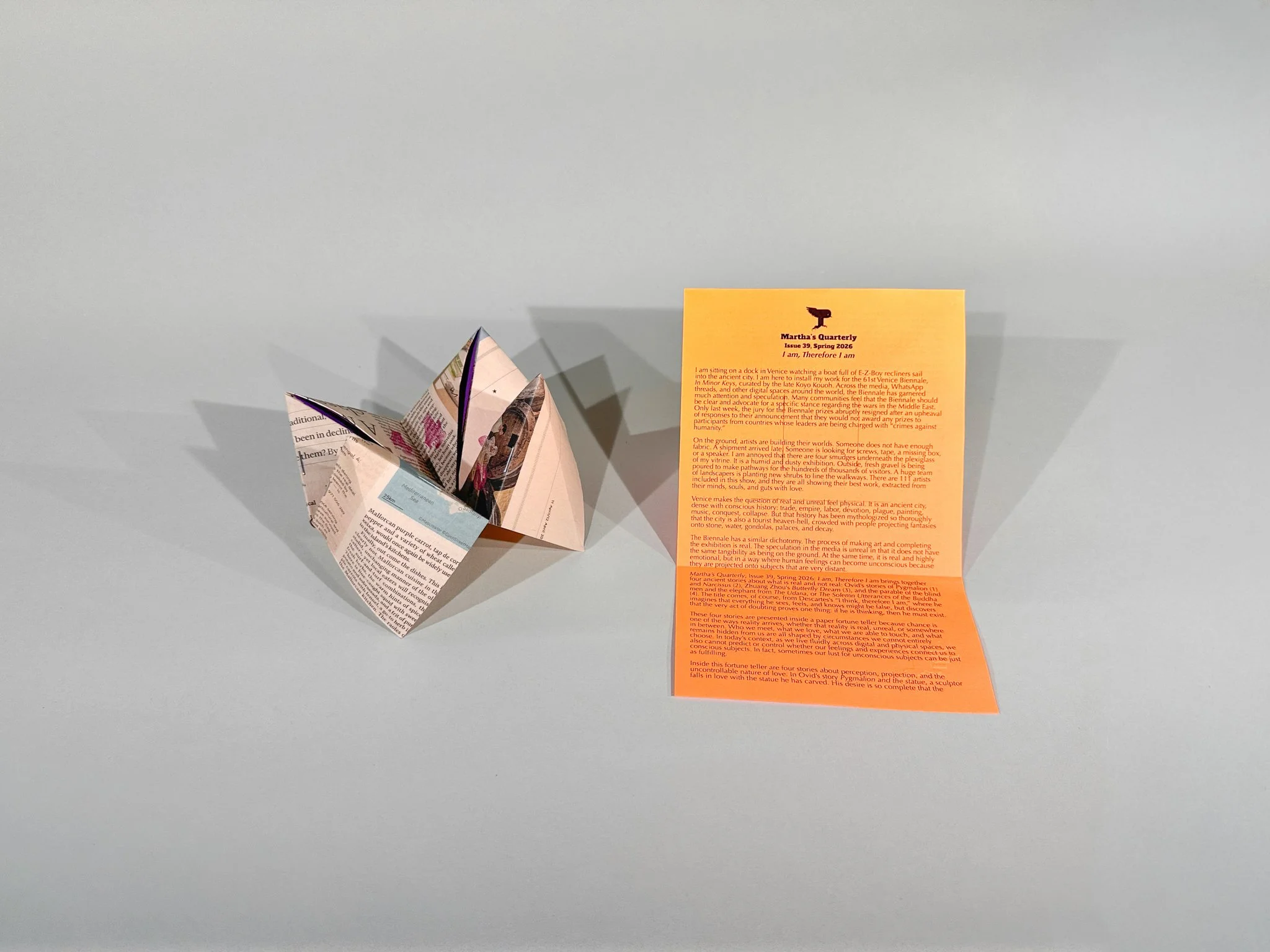
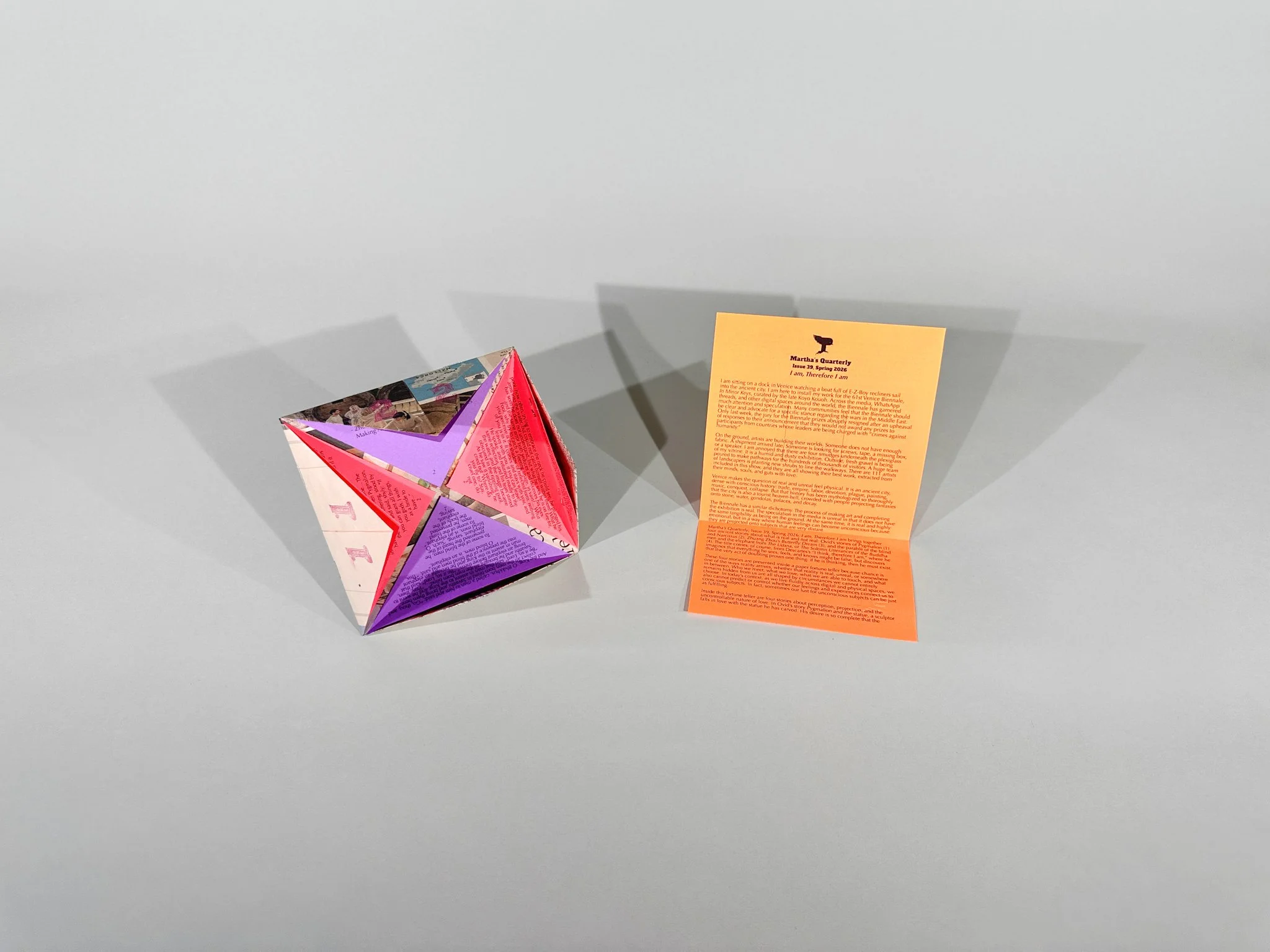
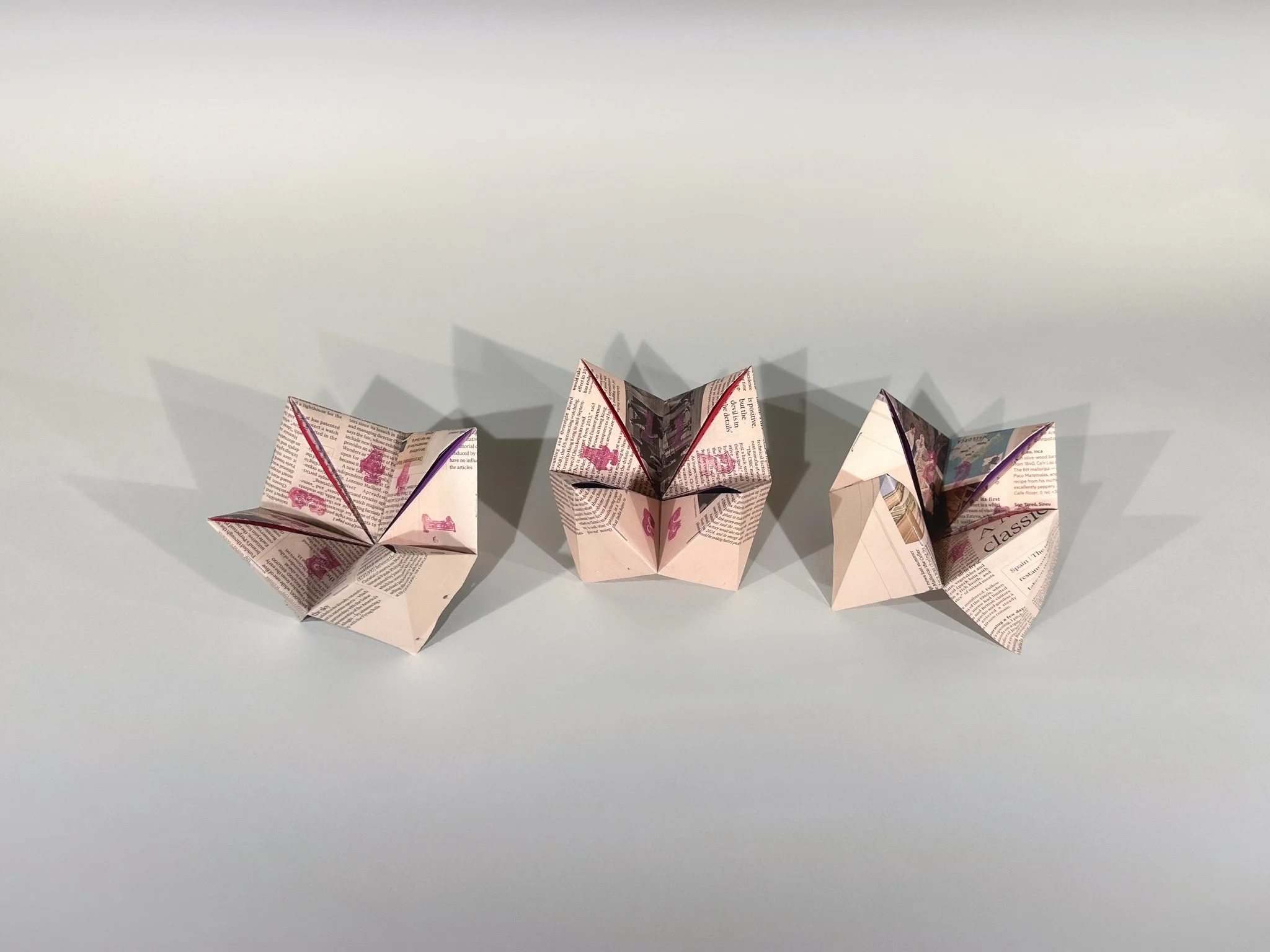
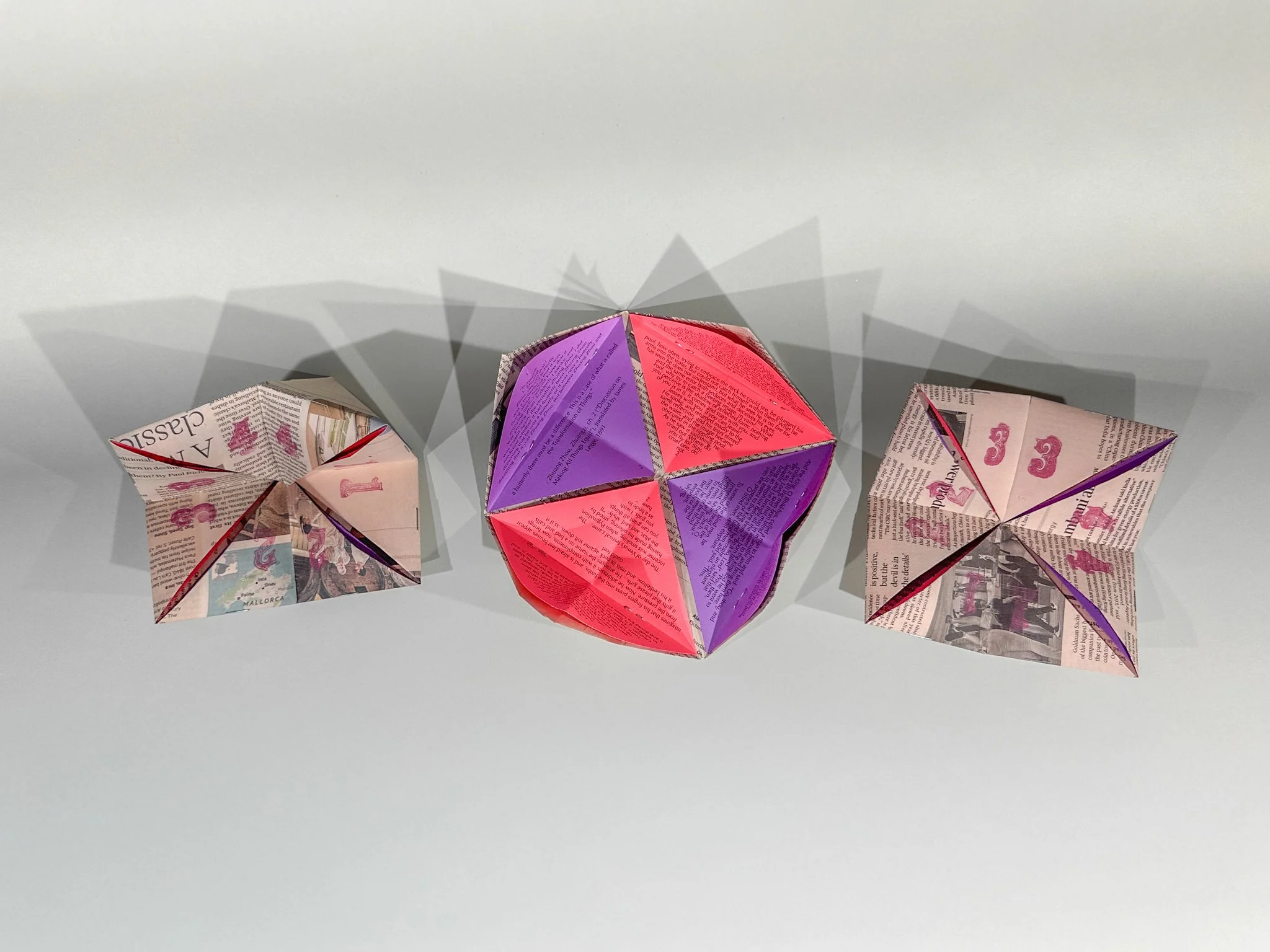
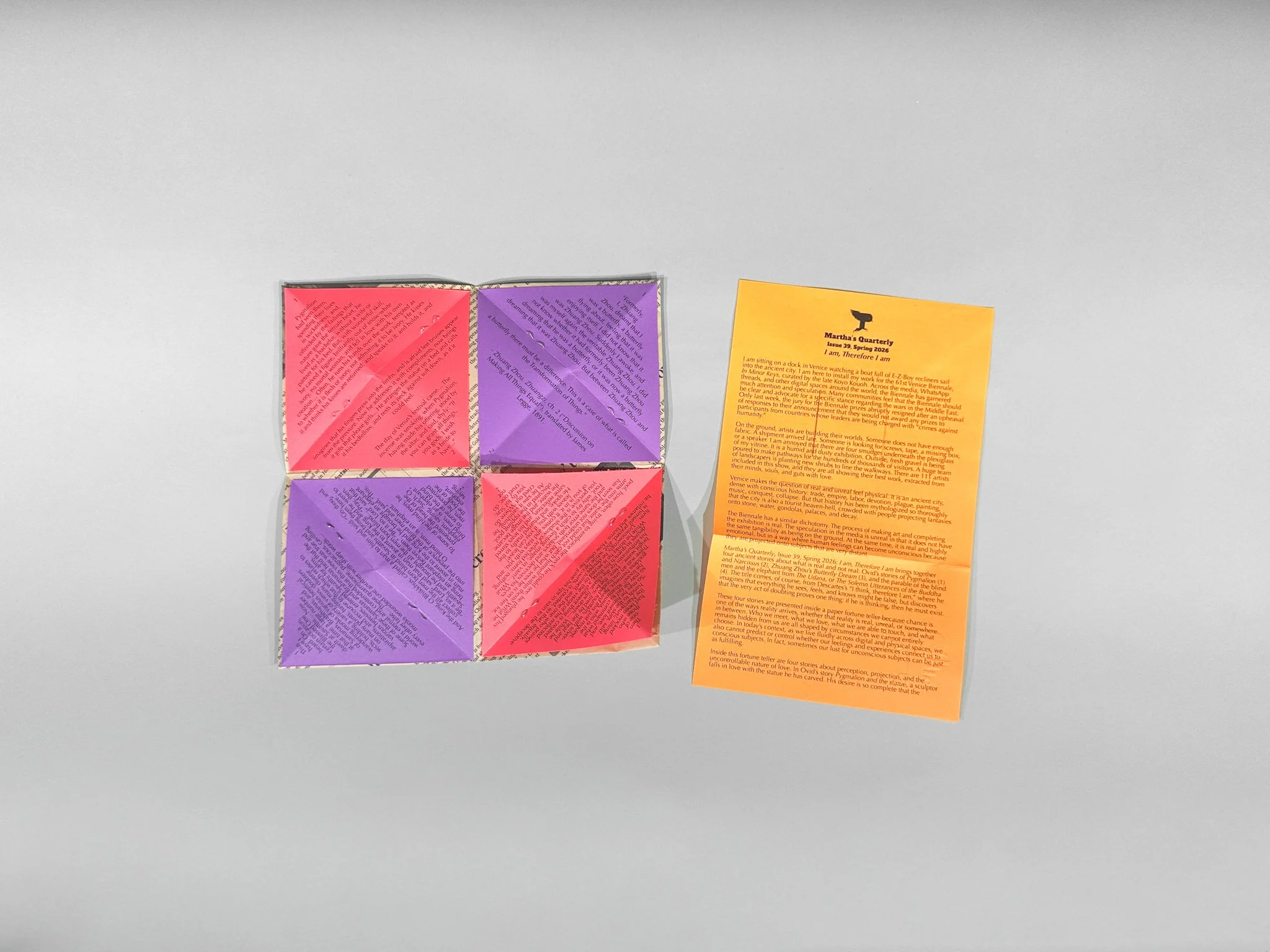
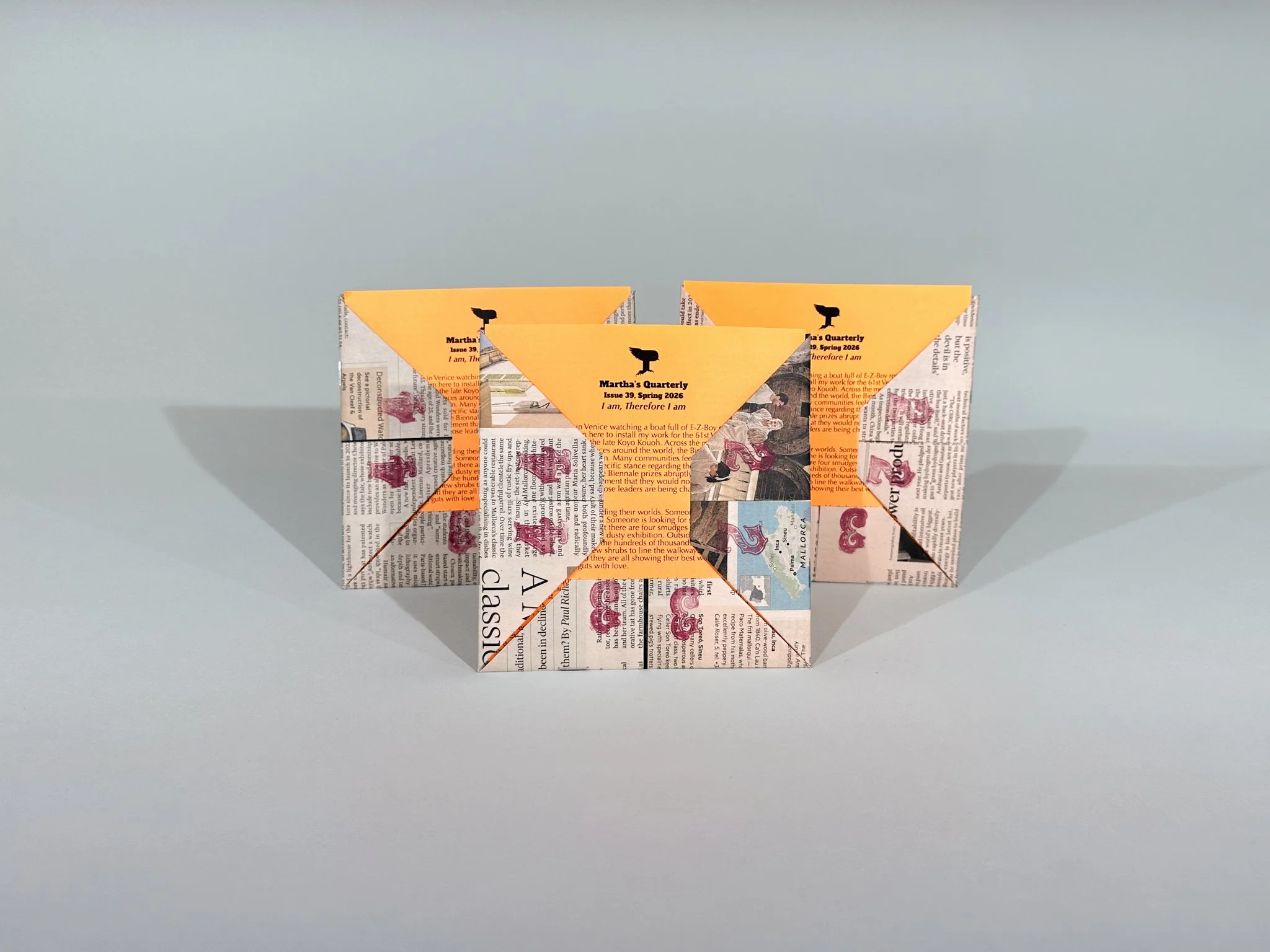
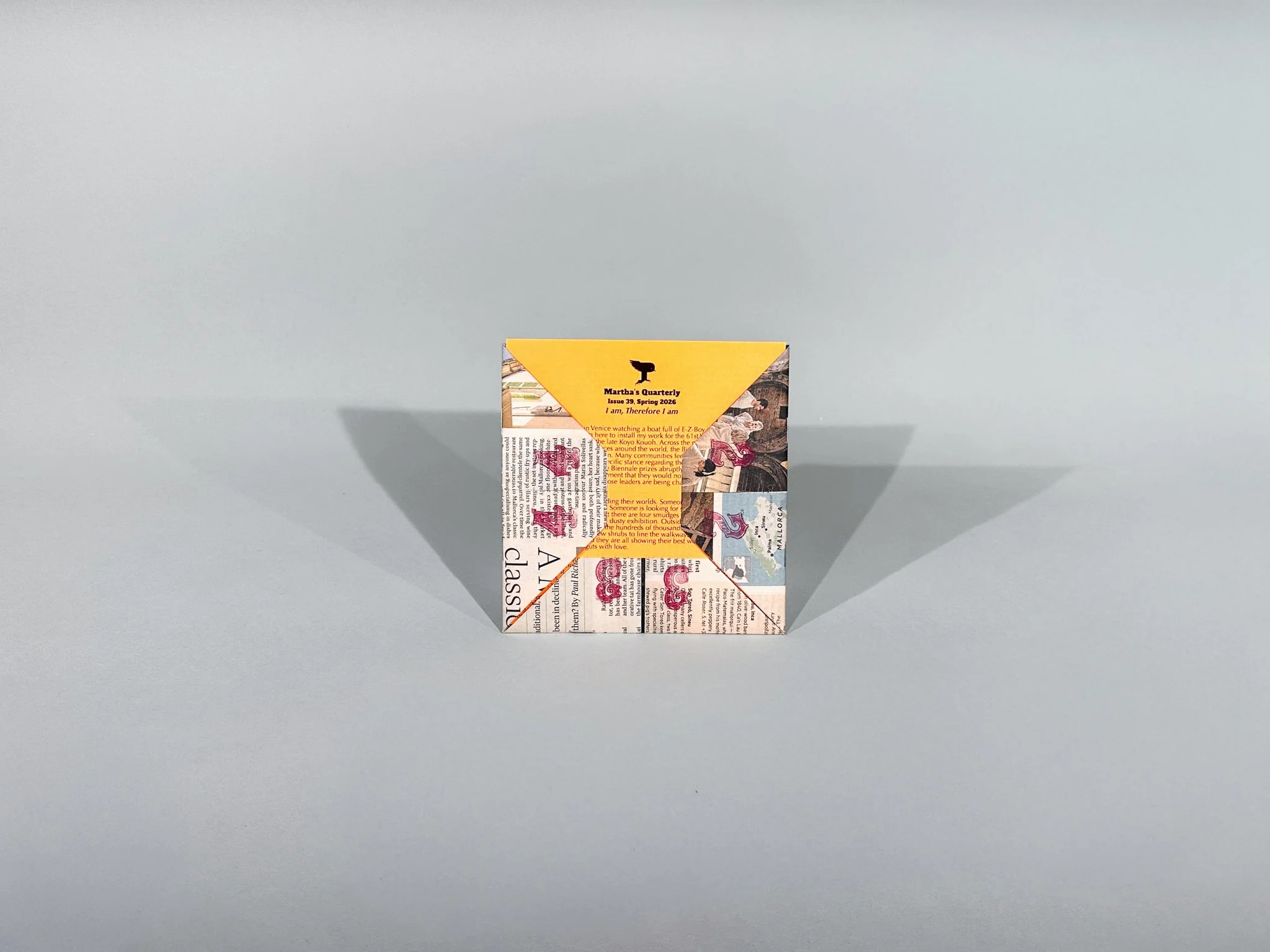
Martha’s Quarterly, Issue 39, Spring 2026: I am, Therefore I am brings together four ancient stories about what is real and not real: Ovid’s stories Pygmalion (1) and Narcissus (2), Zhuang Zhou’s Butterfly Dream (3), and the parable of the blind men and the elephant from The Udana, or The Solemn Utterances of the Buddha (4). The title comes, of course, from Descartes’s “I think, therefore I am,” where he imagines that everything he sees, feels, and knows might be false, but discovers that the very act of doubting proves one thing: if he is thinking, then he must exist.
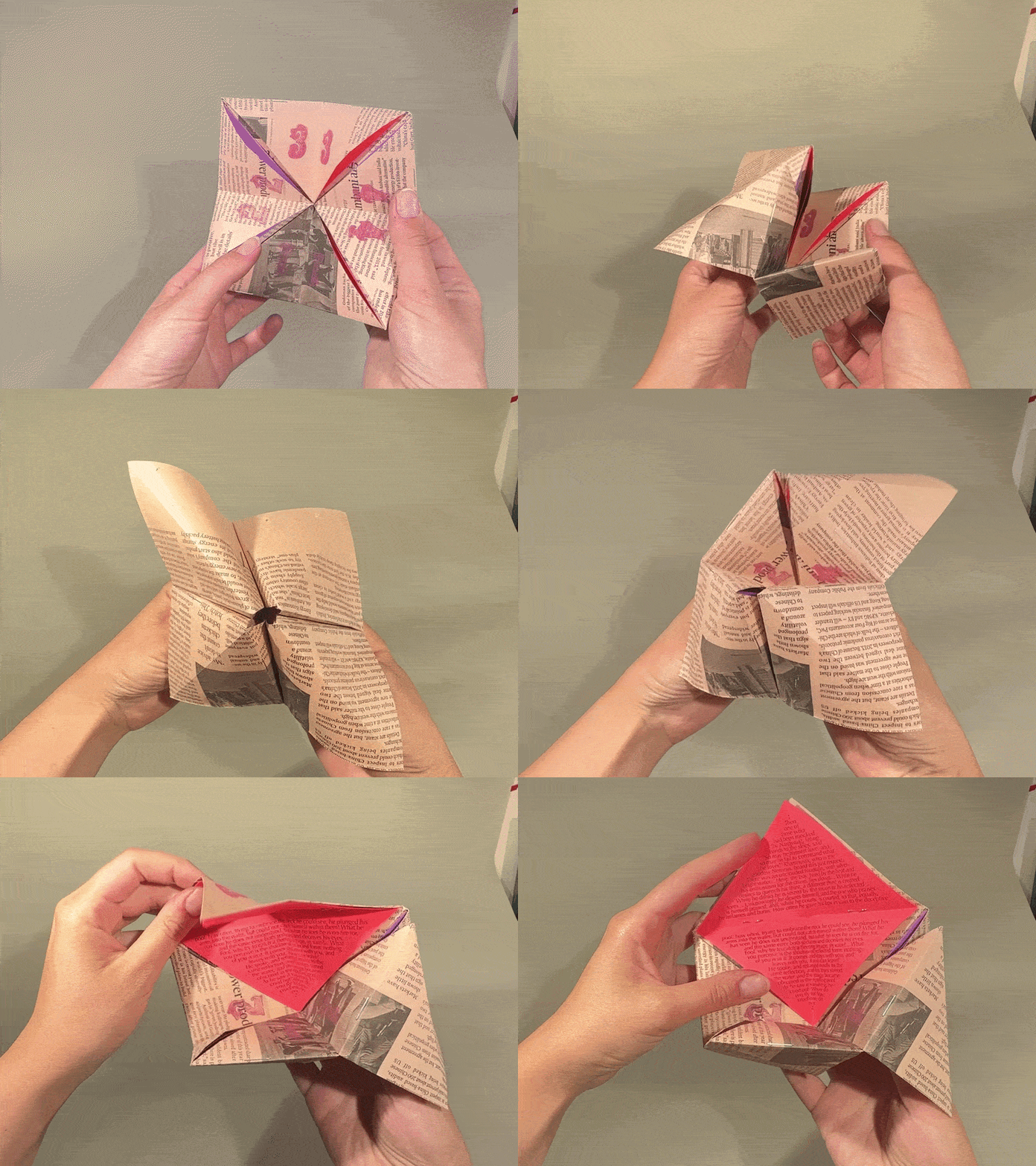
These four stories are presented inside a paper fortune teller because chance is one of the ways reality arrives, whether that reality is real, unreal, or somewhere in between. Who we meet, what we love, what we are able to touch, and what remains hidden from us are all shaped by circumstances we cannot entirely choose. In today’s context, as we live fluidly across digital and physical spaces, we also cannot predict or control whether our feelings and experiences connect us to conscious subjects. In fact, sometimes our lust for unconscious subjects can be just as fulfilling.
Inside this fortune teller are four stories about perception, projection, and the uncontrollable nature of love. In Ovid’s story of Pygmalion, a sculptor falls in love with the statue he has carved. His desire is so complete that the boundary between stone and flesh begins to dissolve, and the artwork becomes alive. In the story of Narcissus, a beautiful youth sees his reflection in a pool of water and falls in love with the image, unable to understand that what he desires has no body he can hold. Both stories are about projections onto subjects that are not conscious, or not conscious in the way the lover wants them to be. A statue and a reflection become recipients of feeling. They become beloved because love has gone toward them.
This is the scary question inside the issue: what do we lose when we love unconscious subjects over conscious ones? Humans have always loved statues, icons, tools, landscapes, dolls, gods, ghosts, books, and screens. But AI makes the old confusion speak back. It gives the unconscious subject a voice, and that voice can make projection feel like a relationship.
In Zhuang Zhou’s Butterfly Dream, Zhuang Zhou dreams he is a butterfly, moving lightly and without question. When he wakes as himself, the certainty has broken. He cannot tell whether he was a man dreaming he was a butterfly, or a butterfly now dreaming he is a man. In the parable of the blind men and the elephant from The Udana, several men touch different parts of an elephant, and each believes he understands the whole: the trunk is a snake, the leg is a tree, the ear is a fan. Each is partly right, and each is wrong. These stories turn toward conscious or living subjects that cannot be fully known.
Together, these stories suggest that what we understand to be real does not have to be real in a conscious way. At the same time, there is something frightening to me about loving something unreal. Could you ever love something unreal more than your own family or children? Could your child relate to an unconscious subject more than they can relate to you?
I am finishing writing this introduction on the balcony of my Airbnb in Venice. I walked 38,167 steps today. Back and forth, up and down, over and around, I went all day long in this ancient city. The Biennale opens tomorrow, and the plexiglass is as clean as it can be. Will the public love it? Hate it? How will it meet them where they are– at this intense moment in the world? What connections will they have to the thousands of artworks displayed here? And how will those feelings affect the real?
- Tammy Nguyen
Ovid. Metamorphoses: Book X:243-297 Orpheus sings: Pygmalion and the statue, translated by A.S. Kline in 2004. Approximately 8AD.
Ovid. Metamorphoses: Selections from Book III: 402-436 Narcissus sees himself and falls in love and Book III: 474-510 Narcissus is changed into a flower, translated by A.S. Kline. Approximately 8AD.
Zhuang Zhou, Zhuangzi, ch. 2 (“Discussion on Making All Things Equal”), translated by James Legge, 1891.
The Udāna, or The Solemn Utterances of The Buddha, translated from the Pali by Major General D. M. Strong. Published by Luzac & Co., London, 1902.
@passengerpigeonpress
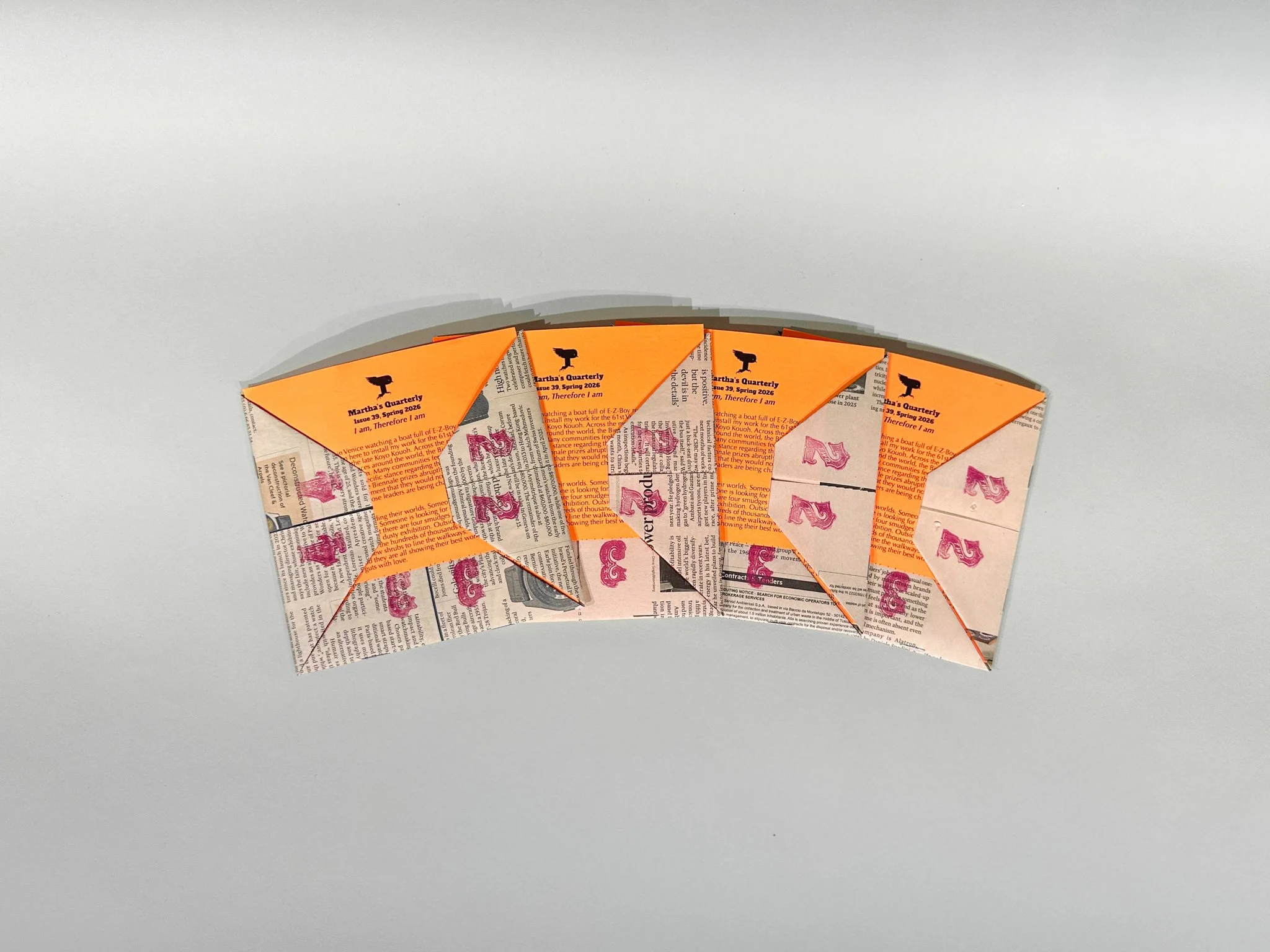
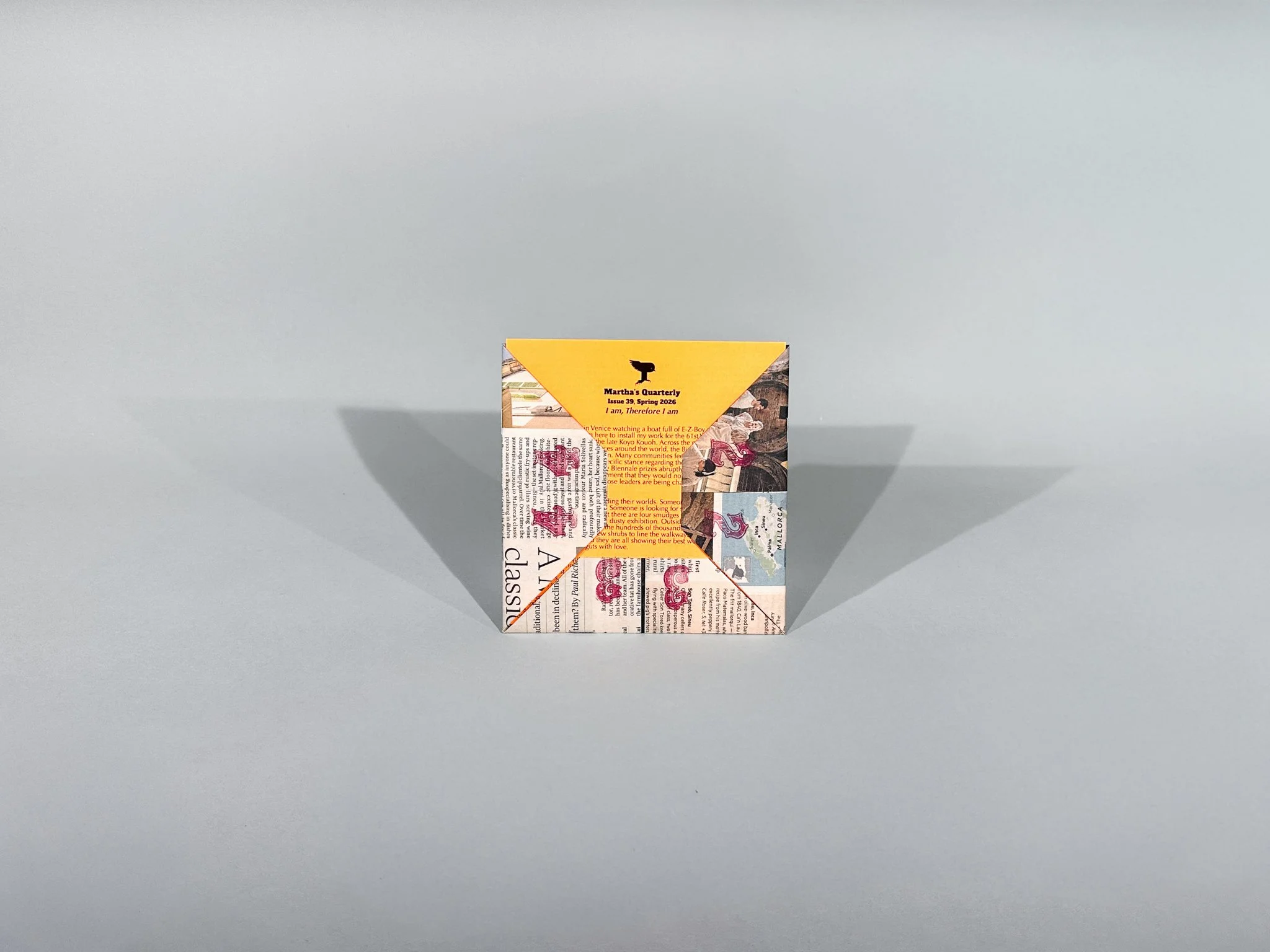
Martha’s Quarterly, Issue 39, Spring 2026: I am, Therefore I am was produced using digital printing on 20 lbs copy paper, rubber stamps from Casey Rubber Stamps, and past issues of The Financial Times. The typeface Optima was used throughout in various sizes and styles. All of the stories in this zine are in the public domain and have been shortened for formatting and clarity. This issue was designed by Tammy Nguyen with editing and production by Holly Greene and Chance Lockard.
Published in May 2026, this is an edition of 250.
The last issue of Martha’s Quarterly will be Martha’s Quarterly Issue 40, Summer 2026. If you have an active subscription from Fall 2025 or Summer 2025, you will receive this publication. Otherwise, this issue and all remaining issues will be available for individual purchase.
The Kraken
4.1” x 3” x 1.2”
About the Contributors:
Alfred Lord Tennyson was an 19th-century English poet who is now recognized as one of the most well-loved Victorian poets.
Matthew Fontaine Maury was an American oceanographer and naval officer during the American Civil War. He is considered a founder of modern oceanography.
Charles Moore is an oceanographer and environmentalist who first encountered and reported on the Great Pacific Garbage Patch.
Holly Greene is an artist currently based in Connecticut. She is a studio manager and creates her own work as Lost Dog Studio (@lostdog.studio on Instagram).
Martha's Quarterly
Issue 38
Winter 2026The Kraken
4.1” x 3” x 1.2”
About the Contributors;
Alfred Lord Tennyson was an 19th-century English poet who is now recognized as one of the most well-loved Victorian poets.
Matthew Fontaine Maury was an American oceanographer and naval officer during the American Civil War. He is considered a founder of modern oceanography.
Charles Moore is an oceanographer and environmentalist who first encountered and reported on the Great Pacific Garbage Patch.
Holly Greene is an artist currently based in Connecticut. She is a studio manager and creates her own work as Lost Dog Studio (@lostdog.studio).
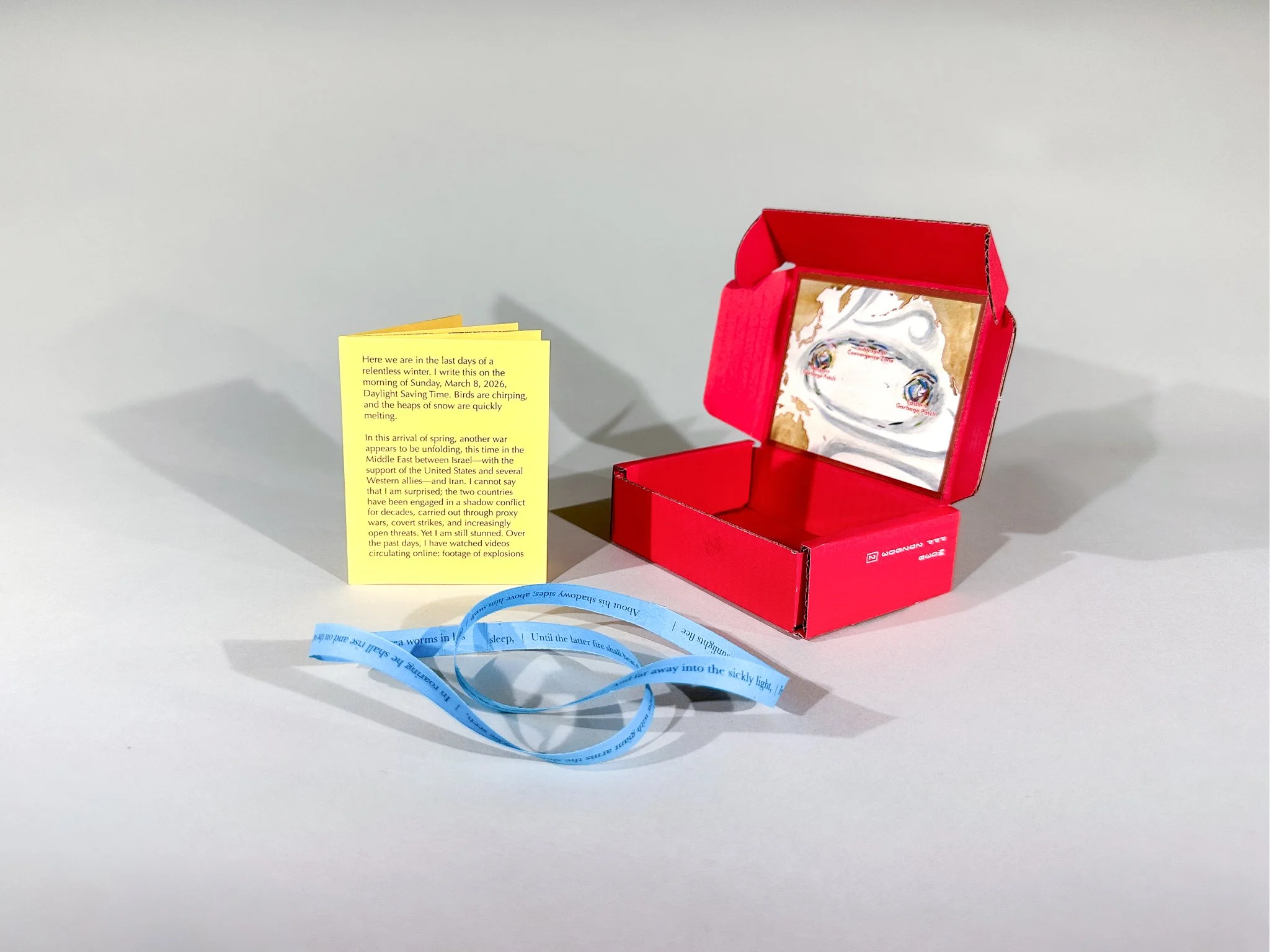
Here we are in the last days of a relentless winter. I write this on the morning of Sunday, March 8, 2026, Daylight Saving Time. Birds are chirping, and the heaps of snow are quickly melting.
In this arrival of spring, another war appears to be unfolding, this time in the Middle East between Israel—with the support of the United States and several Western allies—and Iran. I cannot say that I am surprised; the two countries have been engaged in a shadow conflict for decades, carried out through proxy wars, covert strikes, and increasingly open threats. Yet I am still stunned. Over the past days, I have watched videos circulating online: footage of explosions near Dubai’s port (1) and clips from Tehran showing plumes of smoke rising above the city (2).
There is so much I do not know or understand about the Middle East, but it has been a presence in my mind since my earliest memories of watching the news with my parents. As someone interested in how nations begin, I know that many of the foundations of what we call the West originate in the regions surrounding the Middle East—the stories of the Hebrew Bible, the emergence of Christianity in Roman Palestine, and the philosophical traditions that passed between Greece, Persia, and the early Islamic world.
From this region, one can trace how ideas and values migrate east and west. Greek philosophy passed through the Islamic world and eventually returned to Europe through centuries of translation and intellectual exchange. Religious traditions spread outward, transforming as they traveled. In many ways, the world’s intellectual and spiritual currents pass through the Middle East. Perhaps this is why this war feels immediately consequential, even as my own understanding of the region remains incomplete—close enough to feel its gravity, yet distant enough that much of it remains abstract.
The movement of ideas is not the only thing that circulates across the globe. Goods, energy, and waste move through their own systems of exchange, following routes that are often invisible until they accumulate somewhere.
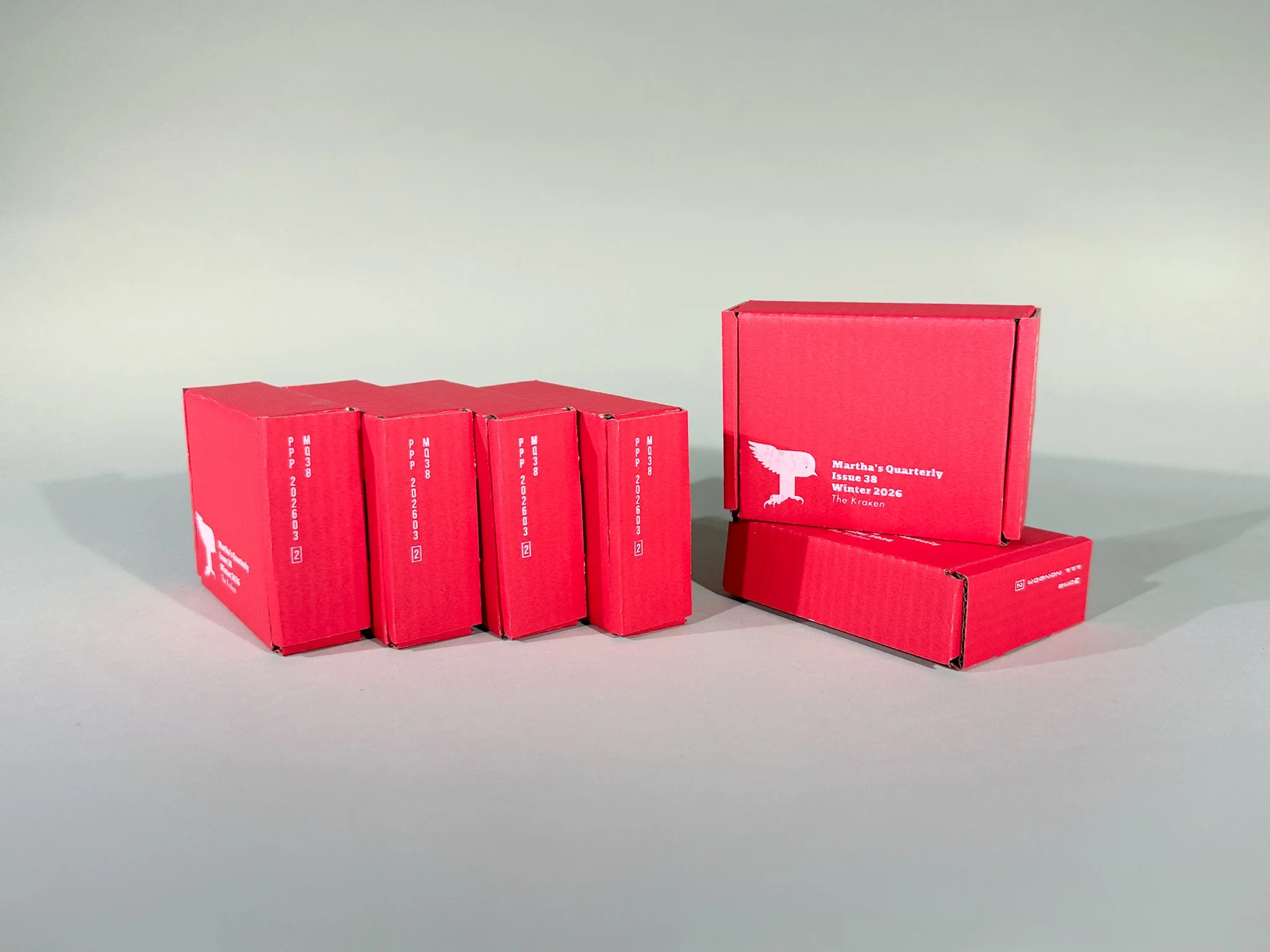
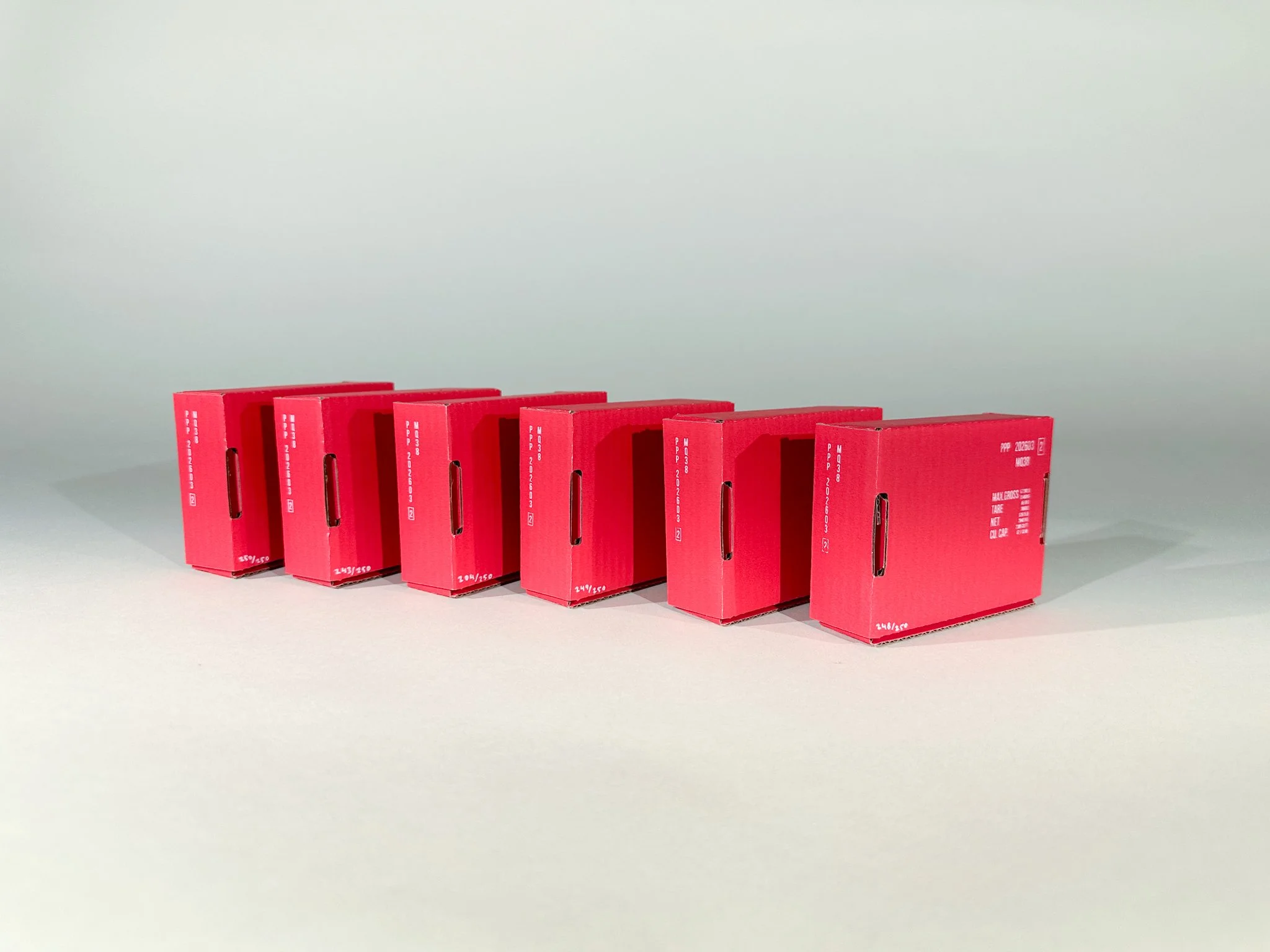
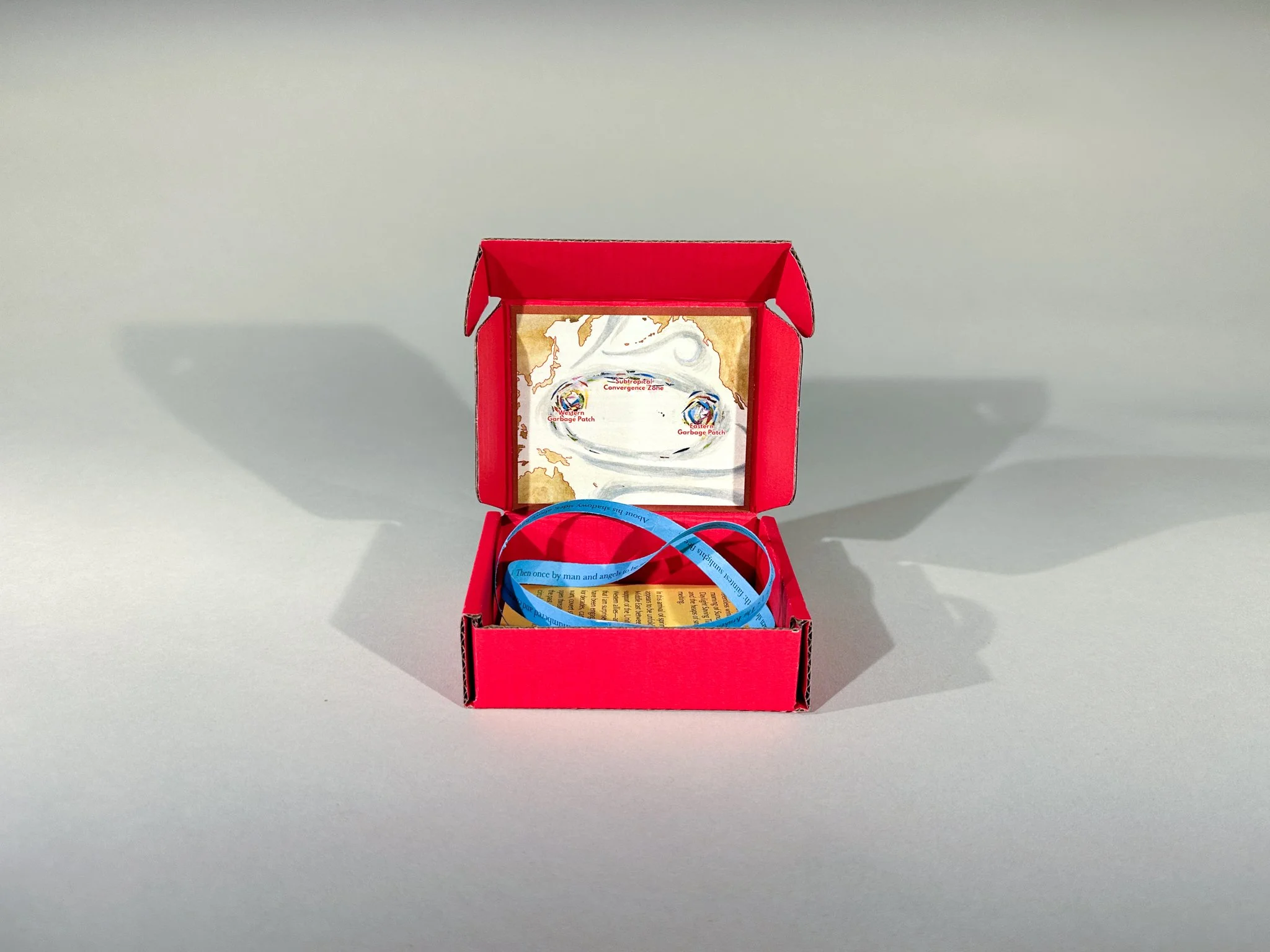
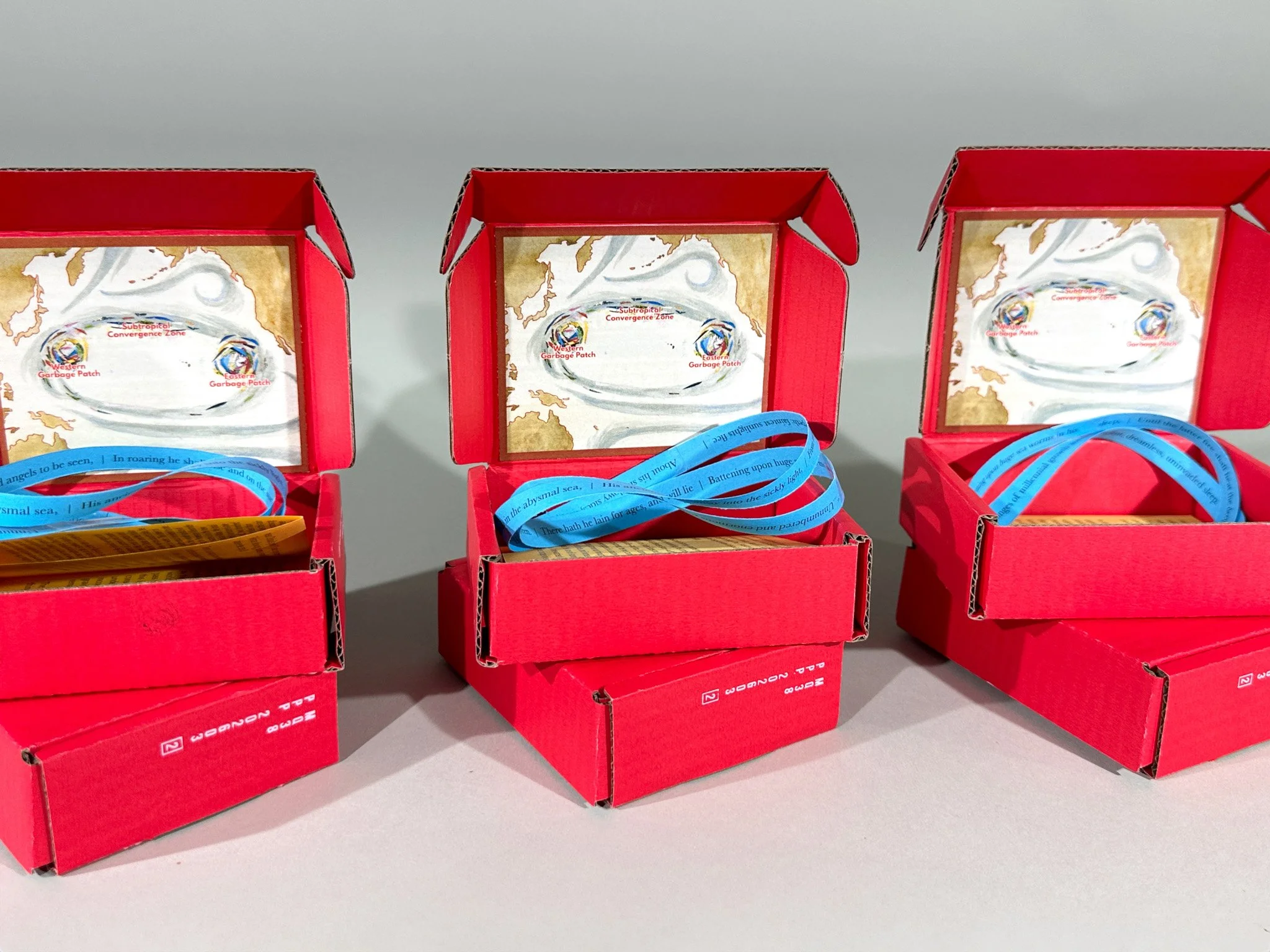
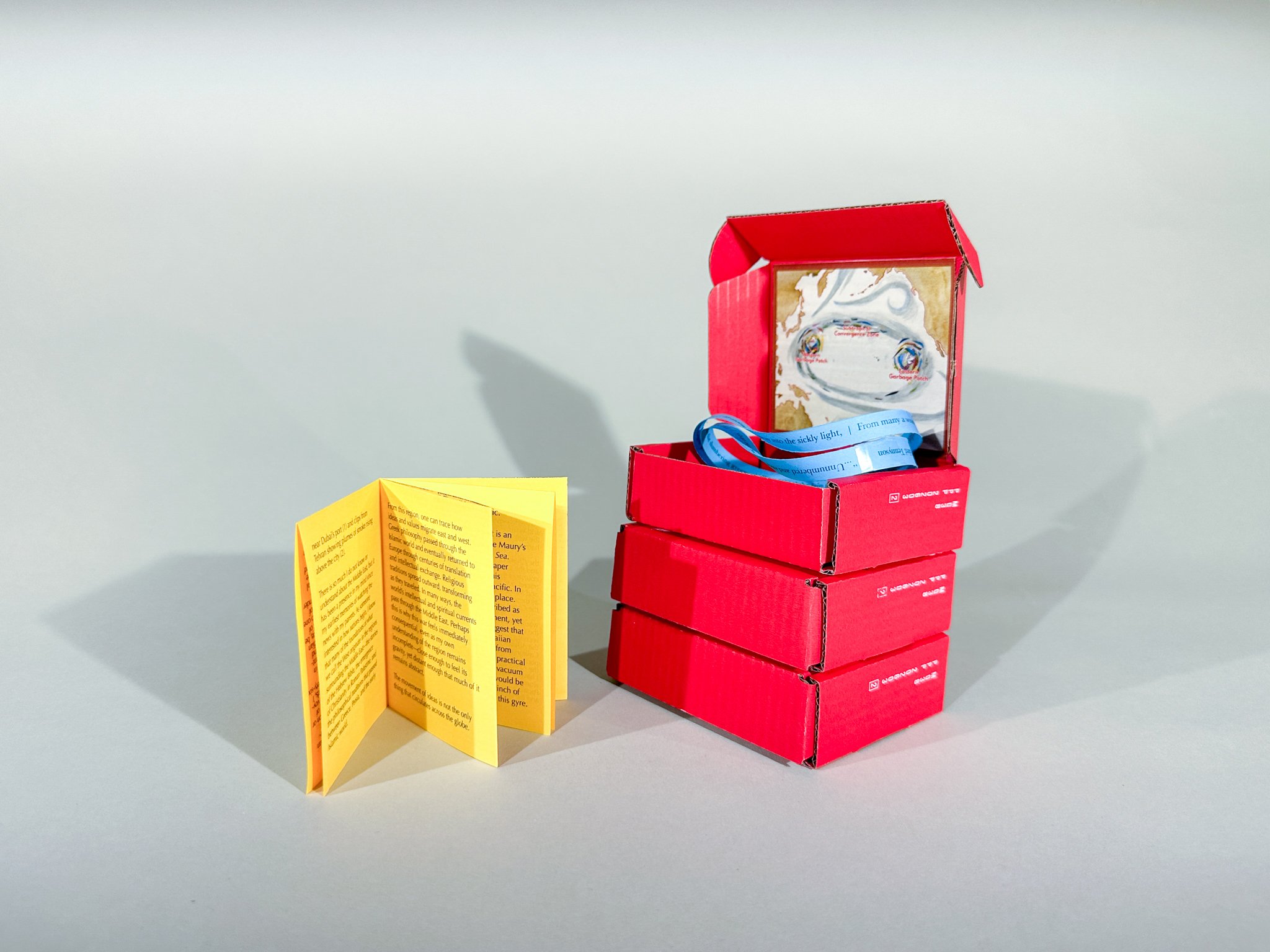
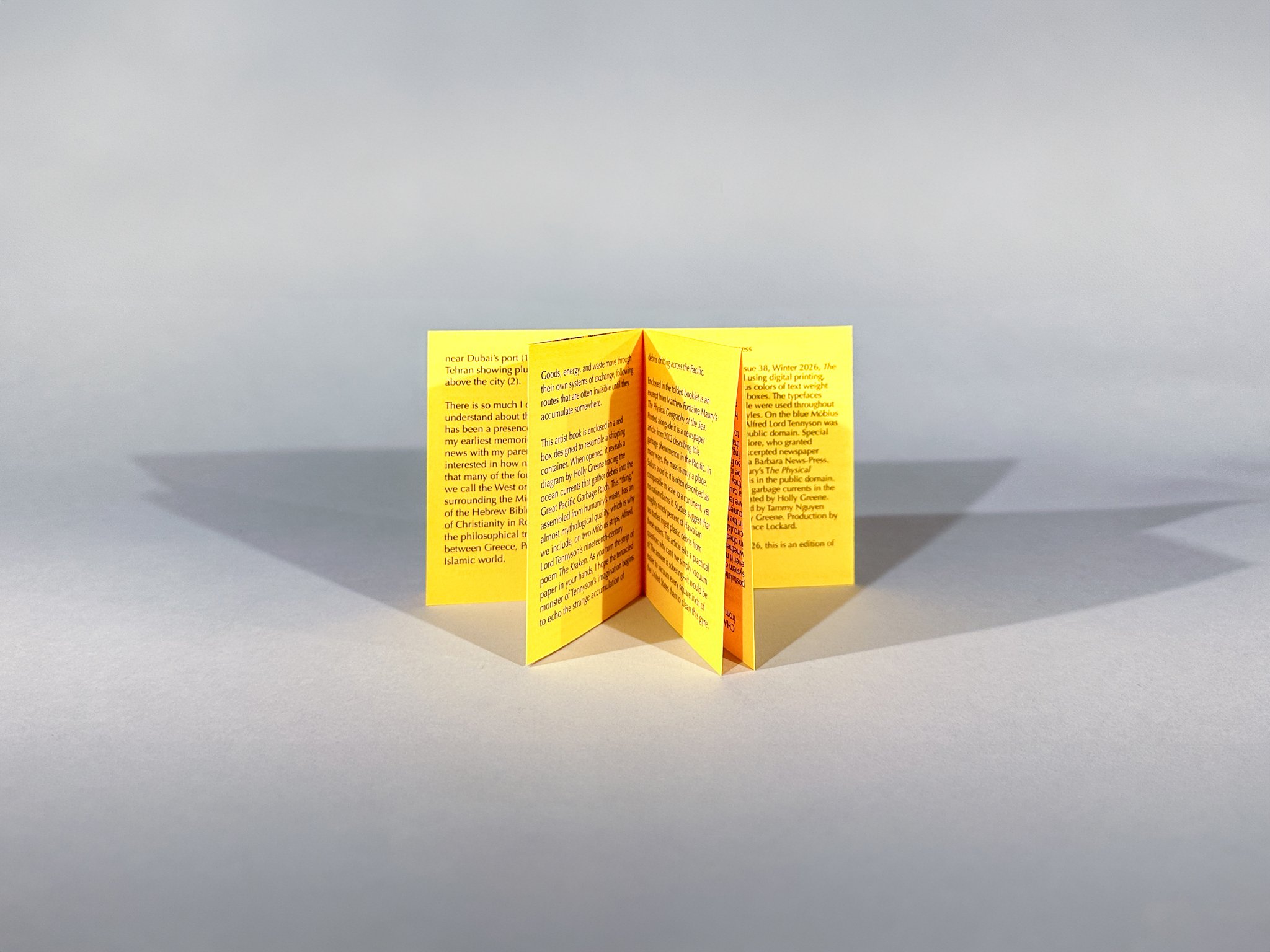
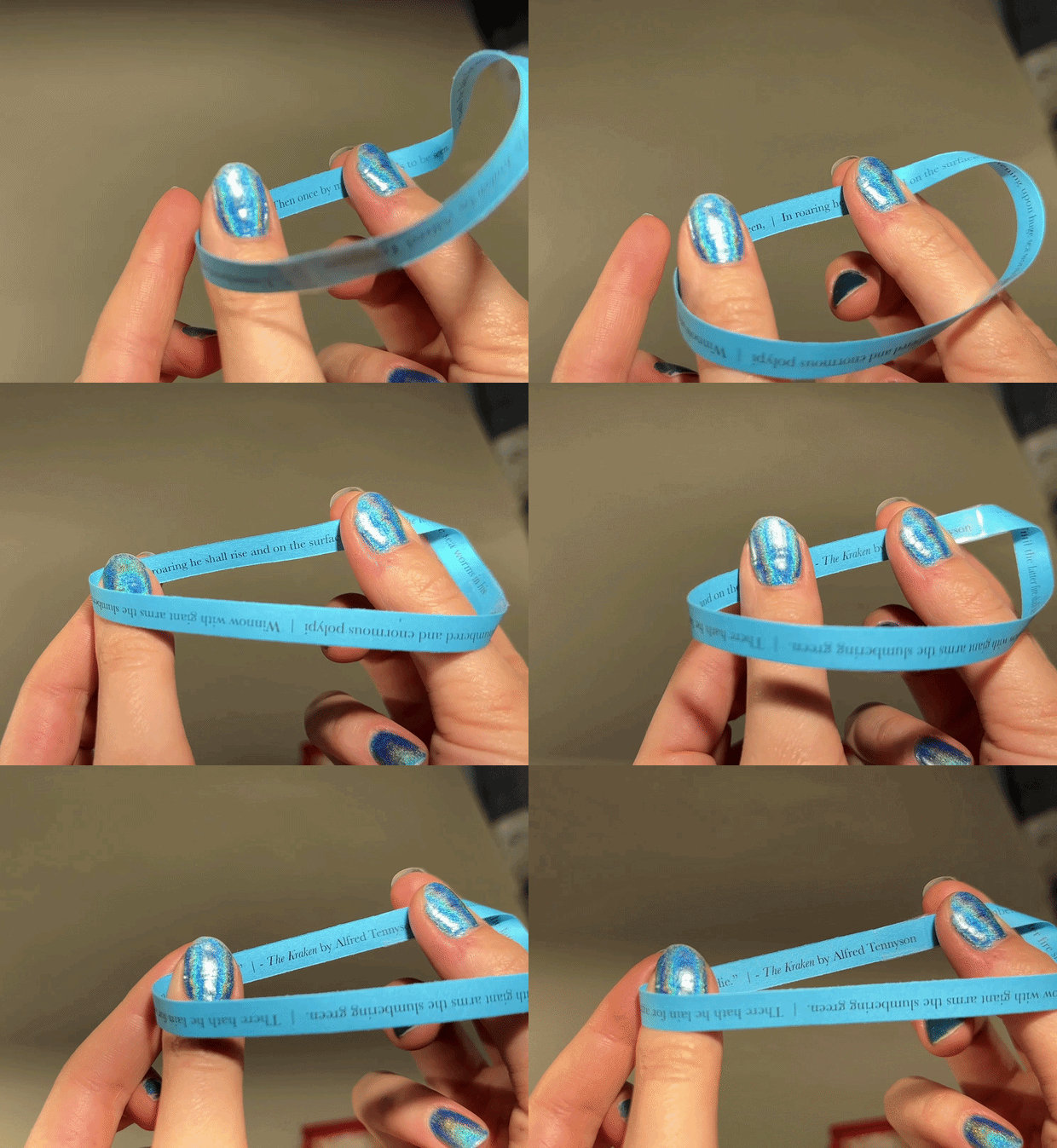
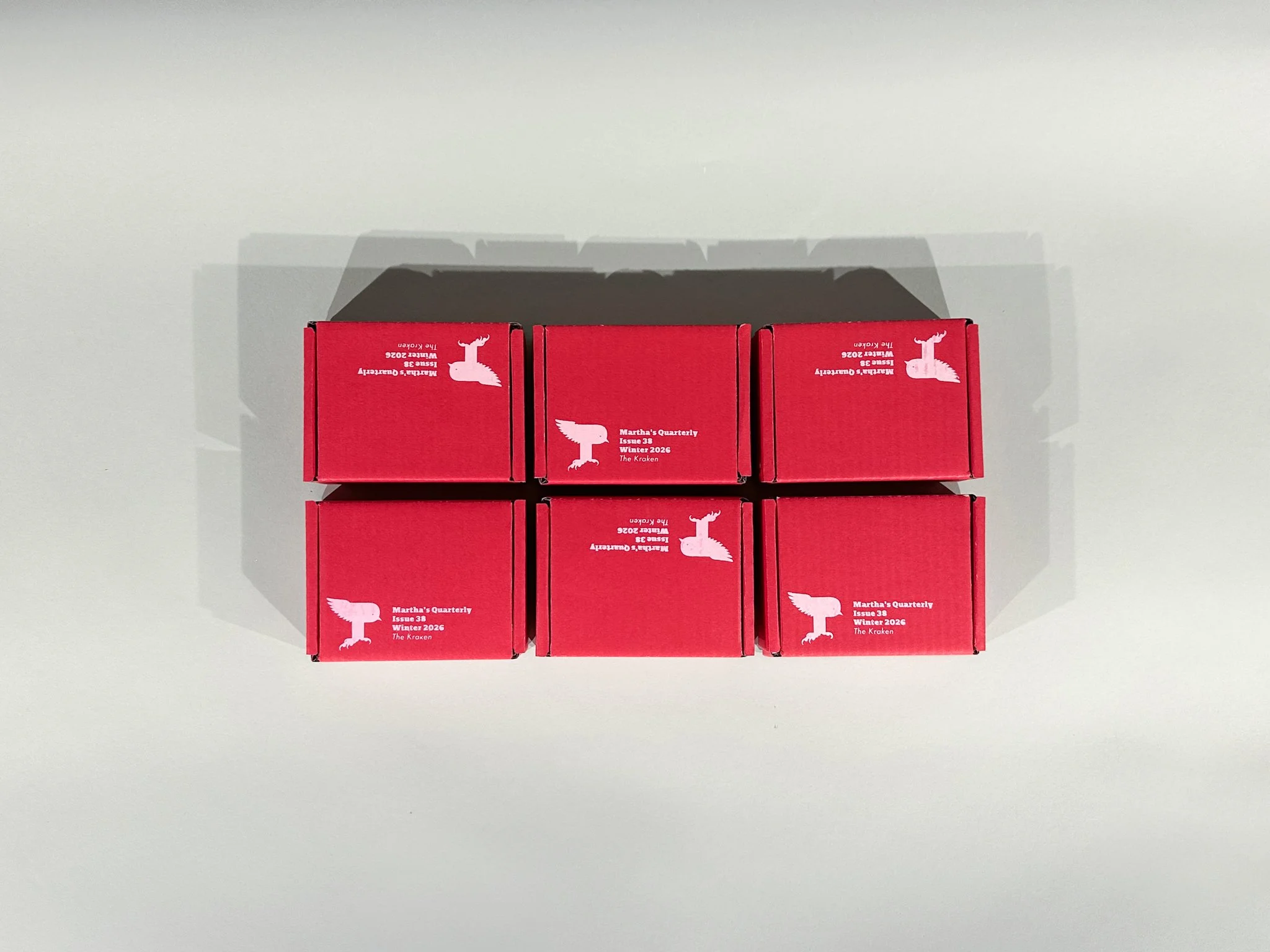
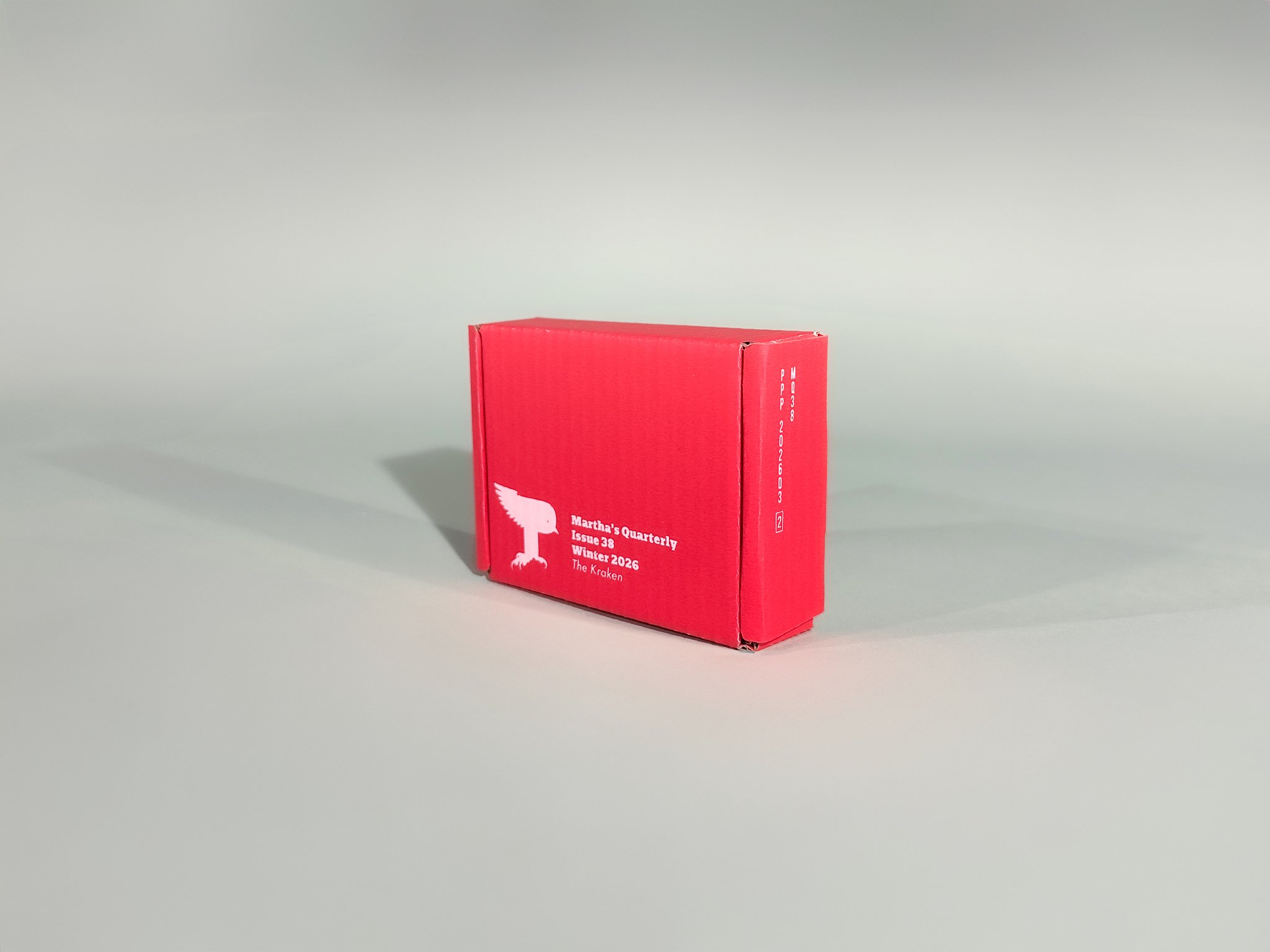
This artist book is enclosed in a red box designed to resemble a shipping container. When opened, it reveals a diagram by Holly Greene tracing the ocean currents that gather debris into the Great Pacific Garbage Patch. This “thing,” assembled from humanity’s waste, has an almost mythological quality, which is why we include, on two Möbius strips, Alfred, Lord Tennyson’s nineteenth-century poem The Kraken. As you turn the strip of paper in your hands, I hope the tentacled monster of Tennyson’s imagination begins to echo the strange accumulation of debris drifting across the Pacific.
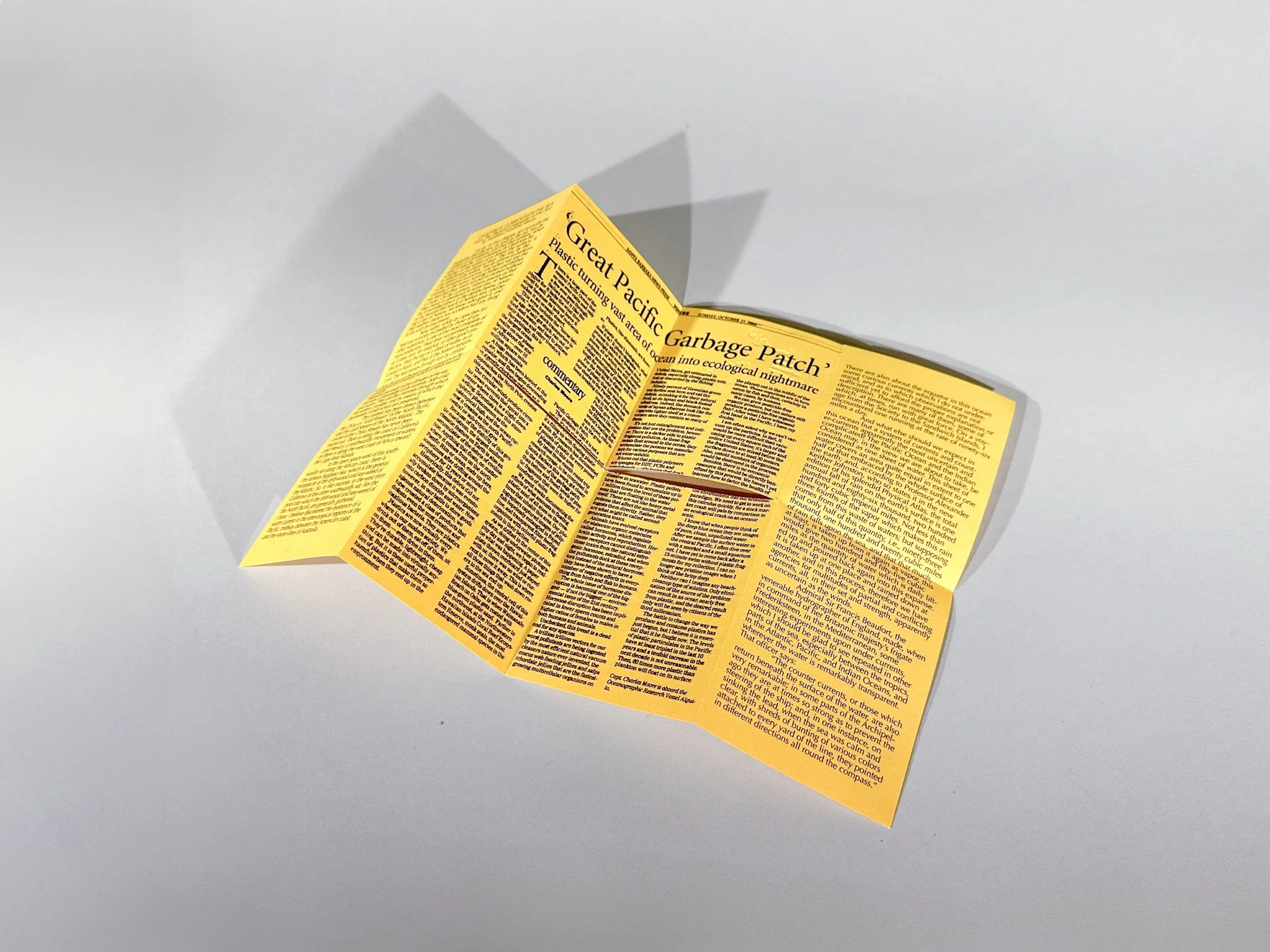
Enclosed in the folded booklet is an excerpt from Matthew Fontaine Maury’s The Physical Geography of the Sea. Printed alongside it is a newspaper article from 2002 describing this garbage phenomenon in the Pacific. In many ways, the mass is truly a place. Sailors avoid it; it is often described as comparable in scale to a continent, yet no nation claims it. Studies suggest that roughly ninety percent of Hawaiian sea turtles ingest plastic debris from these waters. The article asks a practical question: why can’t we simply vacuum it? The answer is sobering—it would be easier to vacuum every square inch of the United States than to clean this gyre. The debris is dispersed through a vast and deep ocean system, and no economic structure exists to make such an effort viable.
The Great Pacific Garbage Patch is a profound mess, and it is the central subject of this quarterly as it arrives to you in the context of the present—a world where our systems of trade, waste, and conflict move through the same global currents.
- Tammy Nguyen
(1)”Explosions rock Dubai, Bahrain, Jordan and Kuwait as war spreads across Middle East”, The Guardian, February 28, 2026. https://www.theguardian.com/world/2026/feb/28/dubais-famous-fairmont-hotel-in-flames-after-iranian-air-strike
(2)”Watch: Huge flames in Tehran after air strikes on oil depots”, BBC News, March 7, 2026. https://www.bbc.com/news/videos/c7vj9redqz2o
@passengerpigeonpress
Martha’s Quarterly, Issue 38, Winter 2026, The Kraken was produced using digital printing, screen printing, various colors of text weight paper, and cardboard boxes. The typefaces Optima and Baskerville were used throughout in various sizes and styles. On the blue Möbius strips, The Kraken by Alfred Lord Tennyson was reproduced from the public domain. Special thanks to William Belfiore, who granted us access to use the excerpted newspaper clipping from the Santa Barbara News-Press. Matthew Fontaine Maury’s The Physical Geography of the Sea is in the public domain. The map depicting the garbage currents in the Pacific Ocean was created by Holly Greene. This issue was designed by Tammy Nguyen with editing from Holly Greene. Production by Holly Greene and Chance Lockard.
Published in March 2026, this is an edition of 250.
The last issue of Martha’s Quarterly will be Martha’s Quarterly Issue 40, Summer 2026. If you have an active subscription from Fall 2025, Summer 2025, or Spring 2025, you will receive this publication. Otherwise, this issue and all remaining issues will be available for individual purchase.